
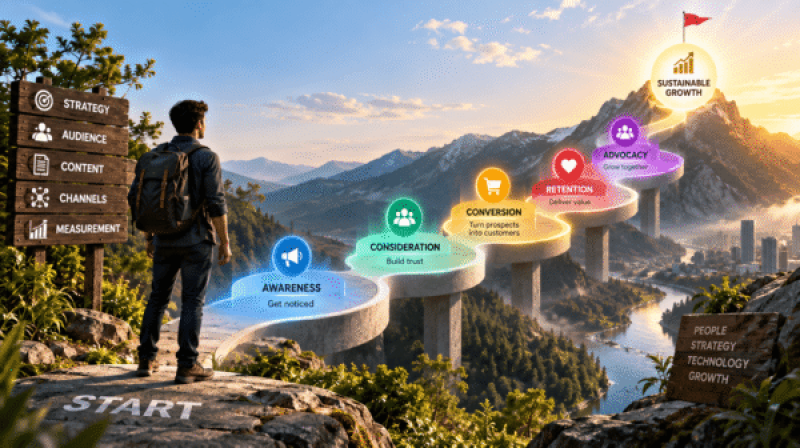
A digital marketing strategy can generate thousands of visitors and still fail to produce meaningful business growth.
The problem is often not a lack of traffic. It is a disconnected customer journey.
Someone may discover your brand through Google, watch one of your videos, visit your website, compare you with competitors, leave without converting, see a retargeting ad weeks later, and finally contact your business through a different channel.
A full-funnel digital marketing strategy connects these interactions into one system.
Instead of treating SEO, social media, paid advertising, content marketing, email, conversion optimisation, and retention as separate activities, a full-funnel approach aligns them around the same customer journey and business objective.
Modern full-funnel marketing increasingly focuses on building a connected system rather than running isolated campaigns. Current industry guidance also emphasises that customers do not always move through the funnel in a perfectly linear sequence.
The practical framework is:
MAP → ATTRACT → NURTURE → CONVERT → RETAIN → OPTIMIZE
What Is a Full-Funnel Digital Marketing Strategy?
A full-funnel digital marketing strategy is an integrated marketing system that supports customers throughout the buying journey—from discovering a problem or brand to evaluating solutions, converting, becoming a customer, and eventually returning or recommending the business.
The traditional funnel is usually divided into four or five stages:
- Awareness
- Consideration
- Conversion
- Retention
- Advocacy
Each stage has a different purpose.
| Awareness | Generate relevant attention | SEO, social, video, content, PR | Reach, impressions, new users |
| Consideration | Build trust and preference | Guides, email, webinars, case studies | Engagement, leads, content interactions |
| Conversion | Generate customers | Search ads, landing pages, demos, offers | Conversion rate, CPA, revenue |
| Retention | Increase customer value | Email, automation, support, loyalty | Repeat purchases, retention, LTV |
| Advocacy | Turn customers into promoters | Reviews, referrals, community | Reviews, referrals, advocacy |
Why Full-Funnel Marketing Matters
Many businesses optimise the part of marketing that is easiest to measure.
For example, a company may invest heavily in paid search because conversions are immediately visible. Another may focus almost entirely on social media engagement because it generates attention.
Both approaches can create problems when they ignore the rest of the journey.
A full-funnel strategy asks:
Where are customers discovering us?
What information do they need before trusting us?
What prevents them from converting?
What happens after they become customers?
How can existing customers generate additional growth?
This creates a more complete view of marketing performance.
Step 1: Define Your Business Goal Before Choosing Channels
The first mistake businesses make is starting with channels.
“Should we run Google Ads or Meta Ads?”
Instead, start with the business outcome.
Your objective might be:
- Generate qualified leads
- Increase ecommerce revenue
- Reduce customer acquisition costs
- Increase repeat purchases
- Launch a new product
- Enter a new market
- Increase brand visibility
- Improve customer lifetime value
Then define measurable targets.
For example:
Revenue goal: Increase qualified pipeline.
This connects marketing activity to actual business performance.
Step 2: Define Your Ideal Customer
A funnel becomes much more effective when it is built around real customer behaviour instead of assumptions.
Define:
- Who your ideal customers are
- What problems they are trying to solve
- What motivates them
- What objections they have
- What alternatives they consider
- What information they search for
- Which channels they use
- How long their decision process takes
- What makes them trust a company
For B2B businesses, also consider the difference between the user, decision-maker, influencer, and buyer.
Customer research can include analytics, CRM data, sales conversations, customer interviews, support questions, reviews, and search behaviour.
Your audience definition should influence the entire funnel.
Step 3: Map the Customer Journey
Before creating campaigns, map what happens from the first interaction to the final purchase.
A simplified journey might look like:
Problem → Search → Discovery → Education → Comparison → Trust → Consultation → Purchase → Retention
Now identify the content and experience needed at each point.
For example:
Awareness
The customer knows they have a problem but may not know your company.
Useful content:
- Educational blog posts
- Videos
- Social content
- Search-optimized guides
- Industry insights
Consideration
The customer understands the problem and is evaluating solutions.
Useful content:
- Comparison pages
- Case studies
- Webinars
- Detailed guides
- Product/service explanations
- FAQs
Conversion
The customer is ready to take action.
Useful assets:
- Landing pages
- Product pages
- Demos
- Consultation forms
- Pricing information
- Testimonials
- Reviews
- Strong calls to action
Retention
The customer has already purchased.
Useful activities:
- Onboarding
- Email sequences
- Customer education
- Support
- Cross-selling
- Loyalty campaigns
- Review requests
Step 4: Build Content for Every Funnel Stage
One of the biggest weaknesses in digital marketing is creating plenty of top-of-funnel content but very little for people who are ready to decide.
A complete content system should cover the entire journey.
TOFU: Awareness Content
Create content that answers broad problems and educational questions.
Examples:
- How-to guides
- Educational articles
- Videos
- Industry trends
- Social posts
- Beginner guides
MOFU: Consideration Content
Help customers evaluate their options.
Examples:
- Comparison articles
- Case studies
- Webinars
- Expert guides
- Solution pages
- Industry reports
- Detailed FAQs
BOFU: Conversion Content
Remove uncertainty and make the next step clear.
Examples:
- Service pages
- Product pages
- Pricing pages
- Demos
- Testimonials
- Reviews
- Consultation pages
Retention Content
Help customers get more value from their purchase.
Examples:
- Onboarding emails
- Tutorials
- Knowledge bases
- Product education
- Customer newsletters
- Loyalty campaigns
Every piece of content should have a job inside the customer journey.
Step 5: Choose Channels Based on Customer Behaviour
No universal list of channels works for every business.
Instead, match channels to customer behaviour.
SEO and Content Marketing
SEO can support both awareness and consideration by helping customers discover useful information when they search for problems, solutions, comparisons, and services.
Social Media
Social platforms can create awareness, demonstrate expertise, build community, and support ongoing customer relationships.
Paid Advertising
Paid search can capture existing demand, while paid social and display can help businesses reach relevant audiences earlier in the journey.
Email Marketing
Email is particularly useful for nurturing prospects and maintaining relationships with existing customers.
Remarketing
Remarketing can reconnect with people who previously interacted with your website or content but were not ready to convert.
The goal is not to be everywhere.
The goal is to be useful where your customers actually spend time and make decisions.
Step 6: Connect the Funnel With Marketing Automation
Once your funnel becomes more complex, manual follow-up can create gaps.
Marketing automation can connect customer actions with relevant next steps.
For example:
Website visit → Content download → Email sequence → Webinar → Sales consultation
Or:
Product view → Cart abandonment → Reminder → Offer → Purchase → Post-purchase email
Automation can also support:
- Lead scoring
- Customer segmentation
- Personalized email sequences
- CRM workflows
- Re-engagement
- Review requests
- Customer onboarding
The objective isn’t to automate everything.
The objective is to deliver the right follow-up at the right stage without losing the human experience.
Step 7: Optimise the Conversion Experience
Getting visitors into your funnel is only half the job.
Your conversion experience must make the next action obvious and easy.
Review:
- Page speed
- Headlines
- Value propositions
- Calls to action
- Forms
- Navigation
- Mobile experience
- Trust signals
- Testimonials
- Reviews
- Pricing clarity
- Checkout process
For example, if a landing page receives significant traffic but produces few leads, increasing traffic may not solve the real problem.
The better question is:
What is preventing qualified visitors from taking the next step?
That mindset turns funnel optimisation into a business process, not just a traffic-generation exercise.
Step 8: Measure Every Funnel Stage
A full-funnel strategy needs full-funnel measurement.
Awareness Metrics
Track:
- Organic visibility
- New users
- Reach
- Impressions
- Brand searches
- Video views
Consideration Metrics
Track:
- Engagement
- Returning visitors
- Content interactions
- Email signups
- Lead quality
- Webinar registrations
Conversion Metrics
Track:
- Conversion rate
- Qualified leads
- Cost per acquisition
- Revenue
- ROAS
- Sales opportunities
Retention Metrics
Track:
- Repeat purchases
- Customer retention
- Churn
- Customer lifetime value
- Referral revenue
- Customer satisfaction
Don’t judge the entire funnel using one metric.
A strong awareness campaign may not generate immediate sales, while a conversion campaign may perform well because earlier marketing created the demand it is capturing.
Criteo’s current full-funnel guidance similarly emphasises measuring upper-funnel influence instead of relying exclusively on last-click conversion reporting.
Step 9: Build for SEO, AEO and AI Search
Modern full-funnel marketing also needs to account for how people discover information through search engines and AI-powered search experiences.
The foundation remains helpful, reliable, people-first SEO.
Google’s current guidance says that its AI Overviews and AI Mode rely on the same foundational Search systems and that there are no additional technical requirements or special AI markup requirements for appearing in these features.
For a full-funnel content strategy, this means:
- Answer real customer questions
- Use clear headings
- Provide direct answers
- Demonstrate genuine expertise
- Add original analysis
- Support important claims with reliable sources
- Build strong internal links
- Keep pages crawlable
- Provide useful images and media
- Maintain good page experience
Google specifically recommends unique, valuable, non-commodity content and warns against producing large amounts of repetitive content primarily to manipulate Search or AI visibility.
So don’t create 50 nearly identical pages to target variations of one keyword.
Create fewer, stronger resources that genuinely help customers make decisions.
Step 10: Optimise the Funnel Continuously
A full-funnel strategy is not something you build once and forget.
Review the funnel regularly.
Look for:
Traffic → Engagement → Leads → Qualified Leads → Sales → Retention
If traffic is high but engagement is low, investigate relevance.
If engagement is strong but leads are weak, investigate the offer and conversion path.
If leads are high but sales are low, investigate lead quality, sales follow-up, pricing, positioning, and trust.
If sales are strong but retention is weak, investigate onboarding, customer experience, product value, and post-purchase communication.
This creates a continuous optimisation cycle:
Measure → Diagnose → Test → Improve → Measure Again