
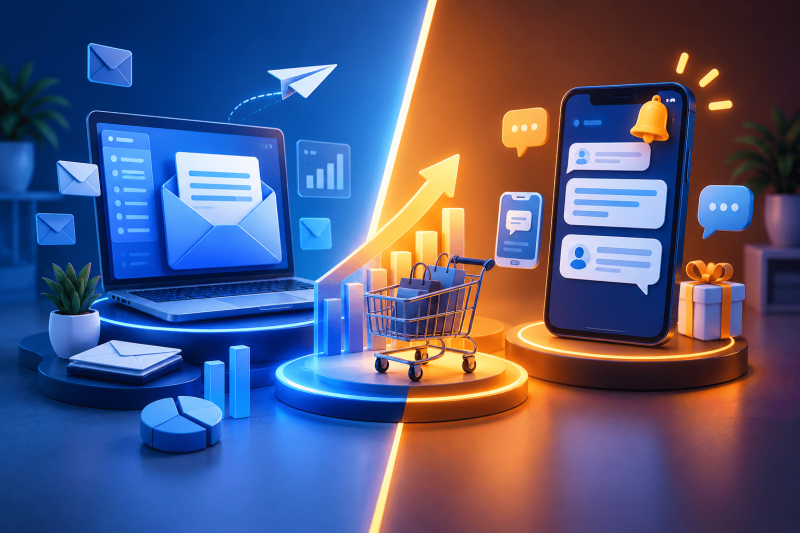
Businesses have more ways than ever to communicate with customers. Two of the most effective channels are email marketing and SMS marketing. Both can generate sales, improve customer engagement, and support long-term relationships, but they work in very different ways.
Email gives businesses more space to educate, inform, and nurture customers, while SMS offers fast and direct communication. The right choice depends on the audience, campaign objective, industry, and type of message.
Rather than asking which channel is always better, businesses should understand where each one performs best.
Understanding Email Marketing
Email marketing involves sending targeted messages to customers or prospects through email. These messages can include promotional offers, product announcements, educational content, newsletters, abandoned-cart reminders, and personalized recommendations.
One of the biggest advantages of email is flexibility. Businesses can create detailed campaigns containing images, product information, links, calls to action, and educational content.
Email is particularly useful when customers need more information before making a purchasing decision.
For example, a software company can use email to explain a product’s features, share case studies, and eventually encourage prospects to book a consultation.
Why SMS Marketing Gets Immediate Attention
SMS marketing communicates with customers through text messages on their mobile phones.
Unlike email, SMS is designed for short and immediate communication. Businesses can use it for limited-time offers, order updates, appointment reminders, delivery notifications, and urgent promotions.
The direct nature of SMS makes it valuable when timing matters.
For example, an ecommerce business running a sale for only a few hours may use SMS to inform existing customers about the offer and encourage immediate action.
However, SMS should be used carefully. Customers may find frequent or irrelevant messages intrusive, so businesses should have clear permission and provide appropriate ways to manage communications.
Email vs. SMS: The Key Differences
Although both channels support digital marketing, their strengths are different.
Email marketing is generally better for:
- Educational content
- Newsletters
- Product information
- Detailed promotions
- Lead nurturing
- Long-term customer relationships
- Automated email sequences
SMS marketing is generally better for:
- Time-sensitive promotions
- Reminders
- Order notifications
- Flash sales
- Short announcements
- Immediate calls to action
The best channel depends on what you want customers to do and how quickly they need to respond.
Which Channel Is Better for Sales?
There is no universal answer.
SMS can be highly effective when a customer already knows the business and receives a relevant message at the right moment. A short promotion with a clear call to action can encourage an immediate response.
Email, on the other hand, can support the entire customer journey. A business can introduce a product, explain its benefits, answer common questions, provide social proof, and follow up with additional messages.
This makes email particularly useful for products or services that require consideration before purchase.
Instead of treating email and SMS as competitors, businesses should consider how the two channels can work together.
Personalization Makes Both Channels Stronger
Sending the same message to every customer is rarely the best approach.
Modern marketing platforms allow businesses to segment audiences based on factors such as previous purchases, browsing activity, interests, engagement, location, and customer lifecycle stage.
For example, an online store could send an email featuring products related to a customer’s previous purchase. If that customer has an abandoned cart, the business could later send a relevant reminder through SMS, where appropriate and permitted.
This combination creates a more personalized customer journey.
Automation Can Improve Marketing Performance
Marketing automation can make both email and SMS campaigns more efficient.
Businesses can create automated sequences based on customer actions.
For example:
- A visitor signs up for an offer.
- They receive a welcome email.
- They receive educational content over the next few days.
- They view a product but do not purchase.
- A relevant follow-up message is triggered.
- After purchasing, they receive confirmation and follow-up communication.
This approach allows businesses to communicate with customers based on behavior instead of relying entirely on manual campaigns.
When Email Marketing Makes More Sense
Email is often the better choice when the customer needs information, education, or multiple interactions before purchasing.
It works especially well for:
- B2B businesses
- SaaS companies
- Professional services
- Ecommerce brands
- Content-driven businesses
- Subscription businesses
A well-designed email campaign can continue providing value long after the initial message is sent.
Email also gives businesses more opportunities to build authority by sharing useful information instead of constantly promoting products.
When SMS Marketing Makes More Sense
SMS can be more appropriate when immediacy is important.
Restaurants, ecommerce brands, appointment-based businesses, event companies, and service providers can use SMS for reminders and time-sensitive communication.
For example, an appointment reminder sent shortly before a scheduled booking can be more useful as a text message than as an email.
The key is relevance. Customers should receive messages that provide genuine value rather than unnecessary notifications.
Why Using Both Channels Can Be More Effective
The strongest strategy is often not email marketing vs. SMS marketing, but email marketing and SMS marketing.
Each channel can perform a different role.
Email can educate and nurture customers, while SMS can deliver important reminders or time-sensitive offers. Together, they can create a connected marketing journey.
For example, an ecommerce business might introduce a new product through email, provide detailed information through a follow-up campaign, and use SMS for a relevant launch reminder.
This gives customers different ways to interact with the brand without forcing one channel to do everything.
Focus on Customer Experience
Regardless of the channel, businesses should avoid sending too many messages.
Customers want relevant communication, not constant promotions.
Before sending an email or SMS, ask:
- Is this message useful?
- Is it relevant to this customer?
- Is the timing appropriate?
- Is the call to action clear?
- Does the customer expect this type of communication?
A customer-focused approach can help protect trust while improving engagement.
Final Thoughts
Email marketing and SMS marketing both have an important place in modern digital marketing.
Email is powerful for education, nurturing, personalization, and detailed communication. SMS is valuable for immediate, concise, and time-sensitive messages.
The best strategy depends on your audience and business goals. Instead of choosing one channel exclusively, businesses can combine email, SMS, automation, segmentation, and customer data to create more relevant marketing experiences.
When every message has a clear purpose and provides value to the customer, both channels can contribute to stronger engagement and more sales.