
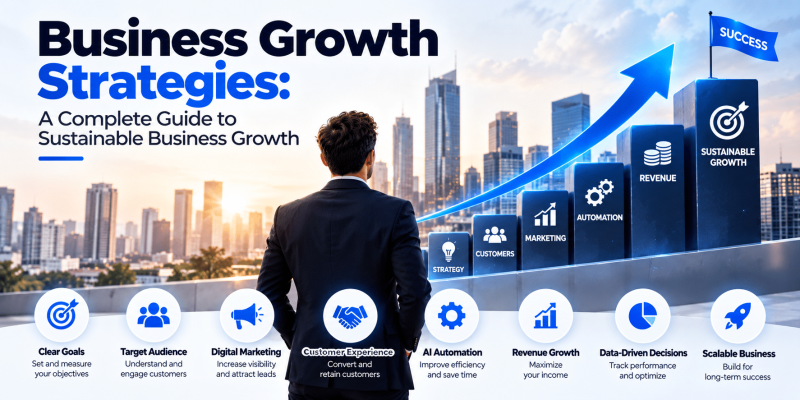
Every business wants to grow, but sustainable growth requires more than increasing sales or attracting new customers. Companies need a clear strategy for reaching the right audience, delivering value, managing resources, and building systems that support long-term success.
Many businesses struggle because their marketing, sales, customer experience, and technology operate separately. They may generate leads without converting them, attract first-time buyers without retaining them, or increase revenue without improving profitability.
Effective business growth strategies connect customer acquisition, revenue generation, operational efficiency, customer retention, and long-term planning into one coordinated approach.
This guide explains nine practical strategies businesses can use to identify growth opportunities, strengthen their market position, and build a more scalable business.
What Are Business Growth Strategies?
Business growth strategies are structured plans that help companies increase revenue, reach new customers, expand into new markets, improve profitability, or strengthen their competitive position.
The right approach depends on the business model, industry, available resources, customer needs, and growth objectives.
For example, a small service provider might prioritize local SEO and referral partnerships, while an ecommerce company may focus on improving conversion rates, customer retention, and product discovery.
Growth does not always mean expanding into new markets or hiring more employees. Sometimes, improving an existing sales process or reducing operational inefficiencies creates greater value than pursuing additional customers.
The first step is to identify what is limiting growth and choose strategies that address the underlying problem.
1. Set Clear Business Goals and Identify Growth Opportunities
Successful business growth starts with a clear understanding of your current position and desired outcomes.
Instead of setting a vague objective such as “grow the business,” establish a measurable goal linked to a specific business priority.
Your objectives might include increasing qualified leads, improving customer retention, expanding into a new market, increasing average order value, or reducing the time required to deliver a service.
Start by reviewing your existing performance, customer feedback, competitors, revenue sources, and operational challenges.
Then identify the opportunities with the strongest potential value and realistic implementation requirements.
How to put this strategy into practice
Review current revenue, costs, customer acquisition, and retention.
Identify your most profitable products, services, and customer segments.
Analyze customer feedback and recurring problems.
Set measurable goals with clear deadlines.
Assign ownership and review progress regularly.
A practical growth plan should explain what the business wants to achieve, why the goal matters, and which actions will contribute to it.
2. Understand Your Target Audience and Strengthen Your Positioning
Businesses grow more effectively when they understand who their customers are, what those customers need, and why they should choose their offering.
Without this understanding, marketing messages can become too broad, campaigns may attract the wrong audience, and product development can focus on features customers do not value.
Start by examining customer questions, purchasing behavior, support requests, reviews, and feedback from sales conversations. Combine these insights with market and competitor research.
Use the findings to refine your value proposition: a clear explanation of what you offer, whom you help, and how your solution addresses a meaningful problem.
For example, a software company serving growing businesses might position its service around simplifying repetitive workflows rather than listing every technical feature.
Strong positioning helps align your website content, sales messaging, marketing campaigns, and customer experience.
3. Build a Consistent Digital Marketing and SEO Strategy
Digital marketing can help businesses reach potential customers through search engines, content, social media, paid advertising, and email. However, using every channel simultaneously is not always the most effective approach.
Choose channels based on where your audience searches for information and how customers make purchasing decisions.
Invest in Digital Growth & SEO
Search engine optimization helps improve a website’s ability to appear for relevant searches. A useful SEO strategy includes keyword research, helpful content, technical improvements, internal linking, and appropriate on-page optimization.
For a business selling specialist services, individual service pages can address specific customer needs. Educational articles can answer common questions and help readers understand possible solutions.
Create useful content
Publish practical resources that help customers solve problems, compare options, and make informed decisions. Content should provide meaningful information rather than repeating keywords without adding value.
Use paid campaigns strategically
Paid search and social advertising can help businesses test offers and reach selected audiences. Track campaign costs and meaningful conversions to understand whether the investment supports business objectives.
The goal is to connect marketing activity with qualified leads, sales opportunities, and customer value—not simply increase traffic or impressions.
4. Improve Customer Experience to Increase Conversions
Attracting potential customers is only part of the growth process. Businesses must also make it easy for people to understand their offerings, evaluate their options, and complete the next step.
A confusing website, slow page, complicated checkout, unclear pricing, or delayed response can create unnecessary friction in the customer journey.
Customer Experience Engineering focuses on understanding and improving how people interact with products, services, and digital touchpoints.
Review the journey from discovery to purchase. Identify where visitors abandon forms, where customers ask repeated questions, and where existing processes cause delays.
Then prioritize improvements such as:
Clear website navigation and service information.
Mobile-friendly pages and accessible forms.
Relevant calls to action.
Simpler booking or checkout processes.
Consistent communication across customer touchpoints.
Clear post-purchase support and follow-up.
Measure the effect of changes using appropriate indicators, such as conversion rate, completed inquiries, checkout completion, and customer feedback.
The purpose is to remove barriers that prevent potential customers from receiving value.
5. Focus on Customer Retention and Long-Term Relationships
Acquiring customers is important, but sustainable growth also depends on the ability to retain existing customers and build lasting relationships.
Satisfied customers may return, purchase additional services, renew contracts, or recommend a business to others. Retention opportunities differ by industry, so businesses should understand which relationships are most valuable and why customers continue buying.
A practical retention strategy can include reliable customer support, relevant follow-up communication, onboarding resources, loyalty programs where appropriate, and regular feedback collection.
For service businesses, clear expectations and dependable delivery are essential. For ecommerce companies, useful product information, order updates, convenient support, and a consistent shopping experience can encourage repeat purchases.
Measure retention through indicators suitable for your business, such as repeat purchase rate, renewal rate, churn, customer lifetime value, or customer satisfaction.
Do not assume every customer needs the same communication. Relevant, timely interactions usually offer more value than unnecessary promotional messages.
6. Use AI Automation and Digital Transformation to Improve Efficiency
As businesses grow, manual processes can create bottlenecks. Employees may spend significant time updating records, transferring information between systems, generating routine reports, or following up on straightforward requests.
AI automation and digital transformation can help businesses evaluate these workflows and identify opportunities to improve efficiency.
Begin by identifying repetitive tasks, delays, duplication, or errors. Then determine whether process redesign, standard automation, system integration, or AI-assisted tools are appropriate.
Potential applications include:
Automating routine lead assignments and follow-ups.
Connecting customer relationship management systems with other business platforms.
Reducing repetitive administrative work.
Organizing business data for reporting and analysis.
Supporting customer service with carefully reviewed automated assistance.
Automation is not automatically beneficial. A poorly designed process can create errors faster when automated, while unsuitable AI systems can produce inaccurate results or expose sensitive information.
Before implementing a solution, define the expected benefit, review security and privacy requirements, assign human oversight, and measure the results.
TBS Solution provides capabilities related to Digital Transformation, AI Automation, and custom technology solutions that may be relevant when these requirements align with a business’s needs.

7. Develop Revenue Growth Systems and Diversify Opportunities
Revenue growth becomes more manageable when businesses understand how customers move from initial awareness to purchase and repeat business.
Review the full sales journey, including lead generation, qualification, proposals, conversion, onboarding, and retention. Identify where opportunities are being lost and what causes the delays.
Depending on your business, growth opportunities may include improving follow-up procedures, refining service packages, developing complementary products, entering a suitable new market, or building strategic partnerships.
However, adding more revenue streams is not always the right immediate priority. New offerings can increase complexity, require additional investment, or distract the team from the main business.
Evaluate each opportunity based on customer demand, delivery capacity, expected costs, competitive conditions, and its relationship to your existing capabilities.
Revenue Growth Systems should help a business connect customer acquisition, conversion, retention, and performance measurement rather than treat these activities as separate projects.
The objective is to develop a reliable process for identifying opportunities and converting them into profitable customer relationships.
8. Make Data-Driven Decisions and Track the Right KPIs
Business growth strategies need regular evaluation. Without meaningful measurement, companies may continue investing in activities that produce little value or overlook problems that limit performance.
Select key performance indicators (KPIs) that reflect your specific business objectives.
| Business objective | Useful metrics |
|---|---|
| Improve customer acquisition | Qualified leads, cost per lead, customer acquisition cost |
| Increase sales | Conversion rate, sales revenue, average order value |
| Improve retention | Repeat purchase rate, renewal rate, customer churn |
| Improve profitability | Gross margin, operating costs, contribution margin |
| Strengthen SEO | Relevant organic traffic, conversions from organic search, search visibility |
| Improve efficiency | Process completion time, error rate, cost per transaction |
Avoid tracking numbers solely because they are easy to measure. Social media followers, website visits, and total leads can provide context, but they do not necessarily indicate profitable growth.
Use dashboards and regular reviews to identify trends, investigate unexpected changes, and decide what to improve next.
Data Intelligence & Executive Insights can support this process by helping businesses organize relevant information and turn it into actionable decisions.
9. Build a Scalable Business and Plan for Long-Term Growth
A business can experience rapid demand and still struggle if its systems, people, and resources cannot support the additional workload.
Before expanding, assess whether your current operations can handle more customers without reducing quality or creating unsustainable costs.
Review delivery processes, employee capacity, documentation, technology, customer support, financial resources, and supplier dependencies.
A scalable business uses repeatable processes and appropriate systems to support growth while maintaining quality and control.
This does not necessarily mean investing in expensive enterprise technology immediately. Start with the simplest reliable solution that meets your current needs and can reasonably support the next stage of development.
As requirements evolve, consider process optimization, appropriate cloud infrastructure, custom software, system integrations, or a stronger ecommerce platform.
TBS Solution’s capabilities include Business Growth & Strategy, Digital Transformation, Business IT Solutions, and eCommerce Growth Platform. These areas may be relevant to organizations planning to connect strategic goals with technology, operations, customer experience, and digital commerce.
Explore the Business Growth Strategy and Digital Transformation pages for more information about TBS Solution’s approach.
A Simple 90-Day Business Growth Plan
You do not need to implement every strategy at once. A focused 90-day plan can help your team prioritize improvements and evaluate progress.
Days 1–30: Assess and prioritize
Review business performance, customer needs, sales processes, marketing channels, costs, and operational constraints. Select one to three priority outcomes and establish baseline measurements.
Days 31–60: Implement focused improvements
Launch the highest-priority initiatives, such as improving a service page, refining lead follow-up, strengthening customer onboarding, or automating a repetitive process.
Assign responsibilities, set deadlines, and monitor early indicators.
Days 61–90: Measure and optimize
Compare current results with the baseline. Identify what worked, what did not, and what needs further investigation.
Continue promising activities, adjust weak approaches, and build the next phase of your growth plan around the evidence collected.
The 90-day framework is a planning tool, not a guarantee of specific results. Some initiatives, particularly SEO and market expansion, may require longer evaluation periods.
Common Business Growth Mistakes to Avoid
Businesses can undermine their growth efforts by pursuing too many priorities simultaneously, expanding without understanding demand, or increasing marketing expenditure without measuring the results.
Other common problems include neglecting customer retention, ignoring profitability, adopting automation without redesigning the process, and making decisions based on incomplete data.
Avoid treating every new technology or marketing trend as an urgent investment. Evaluate whether it addresses a real business need and whether your team has the resources to implement it properly.
Growth should be supported by realistic objectives, clear accountability, sound financial planning, and ongoing improvement.
Frequently Asked Questions
What are the most effective business growth strategies?
The most suitable strategies depend on the business, but common approaches include understanding customer needs, improving digital marketing, increasing conversion rates, retaining customers, optimizing operations, and measuring performance.
How can a small business grow sustainably?
Start with clear goals, a defined target audience, and a focused offer. Improve customer acquisition and retention, monitor profitability, and invest in systems that address genuine operational needs.
How does digital transformation support business growth?
Digital transformation can help businesses improve processes, connect systems, automate repetitive tasks, and create better customer experiences when technology is aligned with specific business objectives.
Why is customer retention important for growth?
Retention can support repeat revenue and long-term customer relationships. Its value depends on the business model, customer behavior, service quality, and the cost of maintaining those relationships.
How should businesses measure growth?
Use metrics that match your objectives, including revenue, profitability, qualified leads, conversion rates, retention, customer acquisition cost, and operational efficiency.
Conclusion
Sustainable business growth comes from making deliberate decisions about customers, marketing, revenue, operations, and technology.
The strongest business growth strategies begin with clear objectives, prioritize genuine customer needs, and use reliable data to guide improvements. They also recognize that acquiring customers is only one part of growth; delivering value, retaining customers, improving efficiency, and maintaining profitability matter just as much.
Start by identifying your most important growth constraint, select a small number of practical initiatives, and measure their impact before expanding your efforts.
With a focused strategy and continuous optimization, businesses can build a stronger foundation for long-term growth and adapt more effectively as their needs evolve.