

Choosing a technology stack is one of the most important technical decisions you can make before starting a website or web application. The technologies you select can influence development speed, Right Technology performance, security, scalability, maintenance costs, and how easily your product can evolve.
But businesses often make one common mistake: choosing technologies because they are popular rather than because they fit the project.
No technology stack is universally perfect.
The right choice depends on what you are building, who will use it, how quickly you need to launch, how much growth you expect, what your team knows, and what your business needs in the future.
This guide explains how to choose the right technology stack for web development Right Technology using a practical framework that moves from business requirements to technical decisions.
What Is a Technology Stack?
A technology stack is the combination of programming languages, frameworks, databases, APIs, infrastructure, and development tools used to build and operate a website or web application.
A typical web development stack can include:
- Frontend: React, Next.js, Angular, Vue.js
- Backend: Node.js, .NET, Python, Java, PHP
- Database: PostgreSQL, MySQL, SQL Server, MongoDB
- APIs: REST, GraphQL, WebSockets
- Infrastructure: AWS, Azure, Google Cloud, or other hosting environments
- DevOps: CI/CD, containers, monitoring, automated testing
- Security: Authentication, authorisation, encryption, vulnerability management
These layers work together rather than operating independently.
For example, an application might use Next.js for the frontend, .NET or Node.js for backend services, PostgreSQL for data, and Azure or AWS for infrastructure.
The specific combination Right Technology should come from the project’s requirements not from a generic list of “best technologies.”
How to Choose the Right Technology Stack
A practical way to approach the decision is:
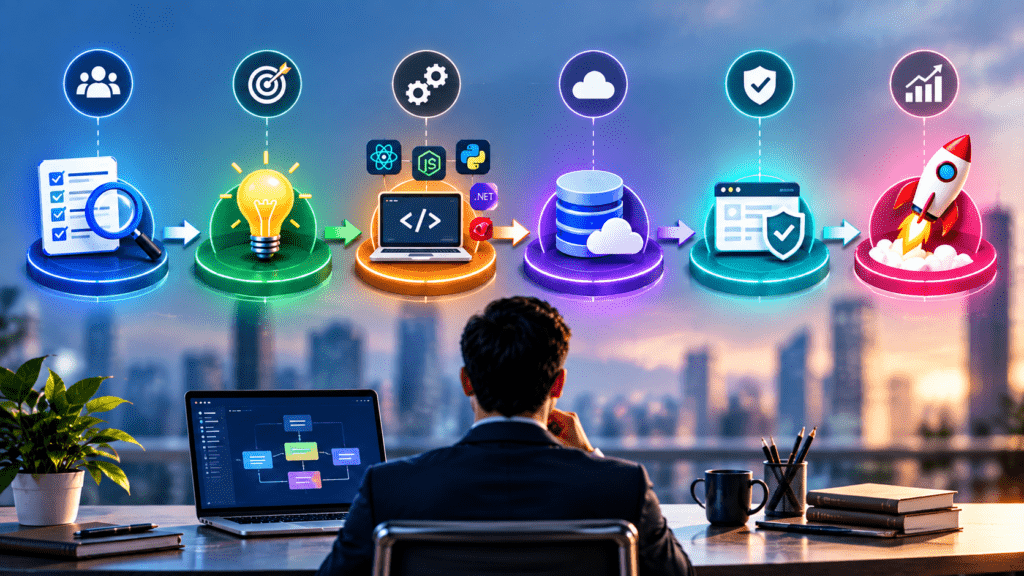
DEFINE → EVALUATE → COMPARE → VALIDATE → SCALE
This framework helps prevent businesses from selecting technology before understanding the problem.
1. Define Your Project Requirements First
Before comparing programming languages or frameworks, define exactly Right Technology what the website or application needs to accomplish.
Ask:
- What problem will the product solve?
- Who are the users?
- Is it a simple business website or a complex web application?
- Will users create accounts?
- Will the application process payments?
- Does it require real-time functionality?
- Will it integrate with third-party services?
- How much data will it manage?
- What features are essential for the first release?
For example, a five-page company website does not require Right Technology the same architecture as a SaaS platform with thousands of users, real-time dashboards, payment processing, and multiple integrations.
Business requirements should determine technical requirements.
This is also consistent with current industry guidance: recent web-development analysis emphasises project requirements, budget, scalability, performance, security, and team expertise as key factors in stack selection.
2. Choose the Frontend Technology
The frontend is the part of the website users see and interact with.
Common frontend technologies include:
- HTML
- CSS
- JavaScript
- TypeScript
- React
- Next.js
- Angular
- Vue.js
The right choice depends on the interface’s complexity.
For a relatively simple website, you may not need a highly complex frontend architecture.
For a large interactive application, a modern framework can better organise Right Technology components, state management, routing, and application behaviour.
Consider:
Performance + User Experience + SEO Requirements + Development Speed + Maintainability
For content-heavy websites, search visibility should also influence architectural decisions. Important content needs to remain accessible to search engines, and Google’s current guidance recommends ensuring important content is available in textual form and that pages are crawlable and indexable.
3. Select the Backend Technologies
The backend handles the logic that users don’t directly see.
It can manage:
- Authentication
- Business rules
- APIs
- Payments
- Data processing
- User accounts
- Integrations
- Server-side operations
Common backend technologies include:
| Node.js | APIs, real-time applications, JavaScript-based teams |
|---|---|
| NET | Enterprise applications and Microsoft-based environments |
| Python/Django | Data-heavy applications and rapid development |
| Java/Spring | Large enterprise systems |
| PHP/Laravel | Web applications and content-driven platforms |
| Ruby on Rails | Rapid application development |
The important point is not which language appears most often on technology lists.
The question is:
Which backend technology can reliably support this application’s requirements with the team and resources available?
4. Choose the Right Database
Your database decision should follow your data requirements.
Common choices include:
- PostgreSQL
- MySQL
- Microsoft SQL Server
- MongoDB
- Redis
- Cloud-managed databases
A relational database may be appropriate when the application depends Right Technology heavily on structured relationships and transactions.
A document-oriented database may be useful for certain flexible data models.
Consider:
- Data structure
- Transaction requirements
- Query patterns
- Expected data volume
- Performance
- Backup requirements
- Security
- Team expertise
Don’t choose a database simply because it is trending.
5. Consider Scalability From the Beginning
A scalable tech stack should allow your application to grow without requiring a complete rebuild every time usage increases.
Think about:
- More users
- More transactions
- More data
- More integrations
- More geographic locations
- More application features
However, scalability does not mean building an extremely complicated architecture from day one.
A startup with 500 expected users doesn’t necessarily need the infrastructure of a global platform with millions of users.
The better approach is to build a foundation that can evolve as demand becomes real.
Recent guidance from GeeksforGeeks similarly highlights scalability, maintainability, performance, security, talent availability, cost, and integration as important dimensions when selecting a technology stack.

6. Evaluate Performance Requirements
Technology choices can affect how quickly your application responds to users.
Evaluate:
- Page loading
- API response times
- Database queries
- Image delivery
- Caching
- Server performance
- Content delivery
- Mobile experience
Performance matters most for customer-facing websites because slow experiences can hurt engagement and conversions.
Don’t optimise everything prematurely, though.
Start by identifying the application’s actual performance requirements, then choose an architecture that can meet them.
7. Don’t Ignore Security
Security should be considered during architecture planning not added after development is complete.
Your technology stack should support appropriate:
- Authentication
- Authorization
- Data protection
- Secure API communication
- Dependency management
- Access controls
- Logging
- Monitoring
- Backup and recovery
If your website processes payments, customer information, health information, financial information, or other sensitive data, security requirements become even more important.
Your development team should also regularly monitor dependencies and address known vulnerabilities.
8. Compare Development Cost and Team Expertise
Technology costs are not limited to software licenses.
Your total cost can include:
Development + Hosting + Infrastructure + Hiring + Maintenance + Monitoring + Security + Future Upgrades
Team expertise also matters.
Suppose one technology is theoretically attractive, but your team has five years of experience with another mature technology.
The familiar option may deliver the project faster and with less risk.
This is one reason experienced teams don’t select a stack based purely on technology popularity.
A 2026 comparison by Timofey Bugaevsky also demonstrates why technology evaluation can involve many different dimensions—including readability, ecosystem stability, security, hiring, performance, and maintainability rather than a single “best stack” metric.
9. Check the Ecosystem and Developer Availability
A technology may look excellent on paper but become difficult to maintain if finding experienced developers is challenging.
Before committing to a stack, consider:
- Developer availability
- Documentation quality
- Community support
- Framework maturity
- Third-party libraries
- Security updates
- Long-term ecosystem health
This matters particularly for businesses planning to maintain a product for several years.
A strong ecosystem can make it easier to hire developers, troubleshoot problems, integrate third-party services, and maintain the application.
10. Plan for Integrations
Modern websites rarely operate alone.
Your application may need to connect with:
- Payment gateways
- CRM systems
- Marketing platforms
- Analytics
- Email services
- Social platforms
- ERP systems
- AI services
- Shipping providers
- Authentication providers
Before selecting a technology stack, check whether the required integrations have reliable APIs, SDKs, libraries, or supported implementation methods.
Integration requirements can significantly influence your backend, database, API, and infrastructure choices.
Understanding a Tech Stack Diagram
A tech stack diagram visually represents how the major technologies in an application connect.
A simplified web application technology stack diagram might look like this:
Users
↓
Frontend
React / Next.js / Angular
↓
Backend / API
Node.js / .NET / Python / PHP
↓
Database
PostgreSQL / SQL Server / MySQL / MongoDB
↓
Third-Party APIs & Services
↓
Cloud Infrastructure
↓
Security + DevOps + Monitoring
The purpose of a technology stack diagram is not decoration.
It helps developers, business owners, project managers, and stakeholders understand how different parts of the system depend on each other.
It can also reveal potential bottlenecks, unnecessary complexity, and integration requirements before development begins.
Popular Technology Stacks: Which One Should You Choose?
Some popular combinations include:
MERN
MongoDB + Express + React + Node.js
Often considered for JavaScriptScript-based web applications.
MEAN
MongoDB + Express + Angular + Node.js
Useful when teams prefer Angular for structured frontend development.
LAMP
Linux + Apache + MySQL + PHP
A mature web development combination with a long history.
.NET Stack
ASP.NET Core + SQL Server + Azure
A strong fit for organisations already operating within Microsoft’s ecosystem.
Python Stack
Python + Django/FastAPI + PostgreSQL
Can suit applications where Python’s ecosystem and development capabilities align with the project.
But view these as examples, not rankings.
There is no universal “best technology stack for web development.” The appropriate choice depends on requirements, constraints, team capabilities, and long-term objectives.
Common Tech Stack Mistakes to Avoid
Choosing technology because it is trending
A popular framework can still be the wrong choice for your project.
Overengineering the first version
Adding unnecessary microservices, tools, and infrastructure can increase complexity and cost.
Ignoring future maintenance
A stack is not finished when the website launches. It needs updates, monitoring, security patches, and ongoing development.
Focusing only on development cost
A cheaper initial build can become expensive if maintenance and scaling are difficult.
Ignoring the development team
The best theoretical architecture means little if the team cannot implement and maintain it effectively.
Selecting too many technologies
Every additional technology introduces another dependency, learning curve, integration point, and maintenance responsibility.
When Should You Work With a Technology Consultant?
You may benefit from technical consulting when the project involves significant architectural decisions, such as:
- Enterprise software
- Complex web applications
- AI integrations
- Cloud migration
- High-traffic platforms
- Multiple APIs
- Large databases
- Legacy-system modernisation
- Advanced security requirements
- Long-term digital transformation
For businesses facing these challenges, technology decisions are also business decisions.
TBS Solution positions its technology work around digital transformation, custom technology solutions, AI automation, cloud infrastructure and DevOps, data intelligence, enterprise software, and quality engineering. Its stated process moves from Discover and Strategise through Execute, Optimise, and Scale.
That broader perspective matters because the right technology stack should support the organisation’s goals—not simply make development possible.
A Simple Technology Stack Selection Checklist
Before approving your stack, ask:
- What exactly are we building?
- Who will use it?
- What features are essential?
- What frontend architecture fits the experience?
- What backend can support the business logic?
- Which database fits the data model?
- What integrations are required?
- How much traffic do we expect?
- What security requirements apply?
- What is our total budget?
- Does our team know the technology?
- Can we hire developers when needed?
- How easy will the system be to maintain?
- Can the architecture scale when the business grows?
If you can answer these questions clearly, your technology decision becomes much more objective.
Frequently Asked Questions
How do I choose the right tech stack?
Start with project requirements, business goals, expected users, performance, security, budget, integrations, team expertise, and future scalability. Then compare technologies against those requirements, rather than choosing based on popularity.
What is the best tech stack for web development?
No single tech stack is best for every website or application. The right stack depends on the project’s functionality, complexity, performance requirements, budget, team expertise, and growth expectations.
What are the main components of a technology stack?
The main components typically include frontend technologies, backend technologies, databases, APIs, PIs, infrastructure, DevOps, security, and monitoring.
What is a scalable tech stack?
A scalable tech stack is an architecture that can handle increasing users, data, traffic, and functionality without unnecessary rework or unacceptable performance problems.
Can I change my technology stack later?
Yes, but changing major architectural components after development can require significant time, cost, testing, and migration work. That is why you should evaluate important technology decisions carefully before development begins.
Should I choose the newest technology?
Not necessarily. New technology can offer useful capabilities, but you should also consider maturity, security, ecosystem support, developer availability, maintainability, and project fit.