

A website or digital product can look visually impressive and still fail if it does not match the way people think, behave, and make decisions.
Users do not interact with interfaces as designers imagine they will. They scan instead of reading every word, form expectations from familiar patterns, notice visual differences, make decisions under limited attention, and sometimes abandon a task when an interface becomes confusing.
That is why user psychology in design matters.
Understanding psychology allows UX teams to move beyond assumptions and design experiences based on how people actually perceive information and interact with digital products. Combined with user research, interaction design, prototyping, and data, psychology can help businesses create interfaces that are easier to understand, navigate, and use.
For businesses investing in digital transformation, customer experience engineering, or enterprise software solutions, this becomes even more important. The interface is not simply a visual layer—it is part of the overall customer experience.
What Is User Psychology in Design?
User psychology in design is the practice of understanding how users perceive information, process choices, respond to visual elements, and behave while interacting with a product or website.
In UX design, psychology can influence decisions such as:
- Where navigation should appear
- How information should be organized
- Which elements should receive visual emphasis
- How many choices users should see at once
- How forms should be structured
- How buttons and calls to action should be presented
- How users understand unfamiliar features
- How trust is established through design
- How feedback should appear after an interaction
The goal is not to manipulate users.
The goal is to reduce unnecessary cognitive effort and make the interface easier to understand.
This distinction is important. Good UX design uses psychological principles to support users in completing their goals rather than creating deceptive patterns that push them toward actions they did not intend to take.
Why Does Psychology Matter in UX Design?
Every design decision creates a response.
A confusing navigation system can increase frustration. A cluttered page can make important information harder to find. An unclear form can cause abandonment. A consistent interface, on the other hand, can make interactions feel familiar and predictable.
Psychology helps designers understand why these reactions happen.
A strong UX process therefore combines:
Psychology + User Research + Interaction Design + Data + Testing
This combination is especially useful when building websites, SaaS platforms, ecommerce experiences, mobile applications, and enterprise systems.
Google’s current people-first guidance also emphasizes original, useful, trustworthy content that genuinely helps users rather than content created primarily to manipulate search rankings. The same principle applies to UX: design should solve real user problems instead of optimizing isolated metrics without understanding the experience behind them.
How User Research Reveals Real Behavior
One of the biggest mistakes in design is assuming that users will behave the way the design team expects.
This is where a user experience researcher becomes valuable.
UX researchers investigate user needs, motivations, frustrations, expectations, and behaviors through structured research methods.
Common behavior research methods include:
- User interviews
- Surveys
- Usability testing
- Observation
- Task analysis
- User journey mapping
- A/B testing
- Heatmaps and interaction data
- Prototype testing
- Quantitative user research methods
Qualitative research can help explain why users behave in a particular way, while quantitative research can show how often a behavior occurs.
For example, analytics might reveal that 40% of visitors abandon a particular checkout step. Quantitative data identifies the problem, but usability research may reveal that users do not understand the shipping terminology.
The design decision should therefore be based on evidence rather than assumptions.
Key Psychological Principles Every UX Designer Should Understand
Several psychological principles have direct applications in digital design.
1. Cognitive Load
Cognitive load refers to the mental effort required to process information.
If a page contains too many options, competing messages, complicated navigation, or unnecessary instructions, users may struggle to determine what to do next.
Good UX reduces unnecessary cognitive load by:
- Grouping related information
- Using clear hierarchy
- Removing unnecessary elements
- Breaking complex processes into manageable steps
- Using familiar patterns
The objective is not to make every interface minimal. It is to make the important information easier to process.
2. Recognition Over Recall
Users generally find it easier to recognize familiar information than remember information from scratch.
For example, a familiar shopping-cart icon requires little explanation. A completely unfamiliar symbol may force users to guess its meaning.
This is why established interface conventions can be useful when they genuinely improve usability.
3. Hick’s Law
When users are presented with more choices, decision-making can become more demanding.
This does not mean every interface should eliminate choices. Instead, designers should organize options logically and provide a clear path toward the user’s goal.
For example, a pricing page with clearly differentiated plans can be easier to understand than a page presenting dozens of similar options.
4. Feedback
Users need confirmation that an interaction has worked.
Examples include:
- A button changing state after submission
- A success message after completing a form
- A loading indicator during processing
- Validation feedback when information is incorrect
Without feedback, users may wonder whether the system responded at all.
How Gestalt Principles Influence Interface Design
Gestalt psychology is particularly relevant to visual interface design because it explains how people perceive relationships between visual elements.
Several Gestalt principles can influence UX decisions.
Closure
The Gestalt principle of closure describes the tendency to mentally complete incomplete shapes or patterns.
In interface design, designers can use partial visual structures, recognizable forms, and carefully constructed layouts to help users understand relationships between elements.
However, clarity should remain the priority. A design should not become intentionally ambiguous simply to appear creative.
Similarity
The principle of similarity suggests that visually similar elements are often perceived as belonging together.
For example, if all primary buttons use the same visual treatment, users can more easily understand that they perform related actions.
Consistency in:
- Color
- Shape
- Typography
- Spacing
- Iconography
can therefore communicate relationships without requiring additional text.
Proximity
Elements positioned close together are often perceived as related.
This is useful when designing forms, dashboards, navigation menus, and content sections.
Continuity
The Gestalt principle of continuity can influence how users visually follow a sequence or path across an interface.
Common Fate
In interactive experiences, elements that move or change together can appear related. This can be particularly relevant to animations, dashboards, and dynamic interfaces.
These principles should support the information architecture rather than replace it.
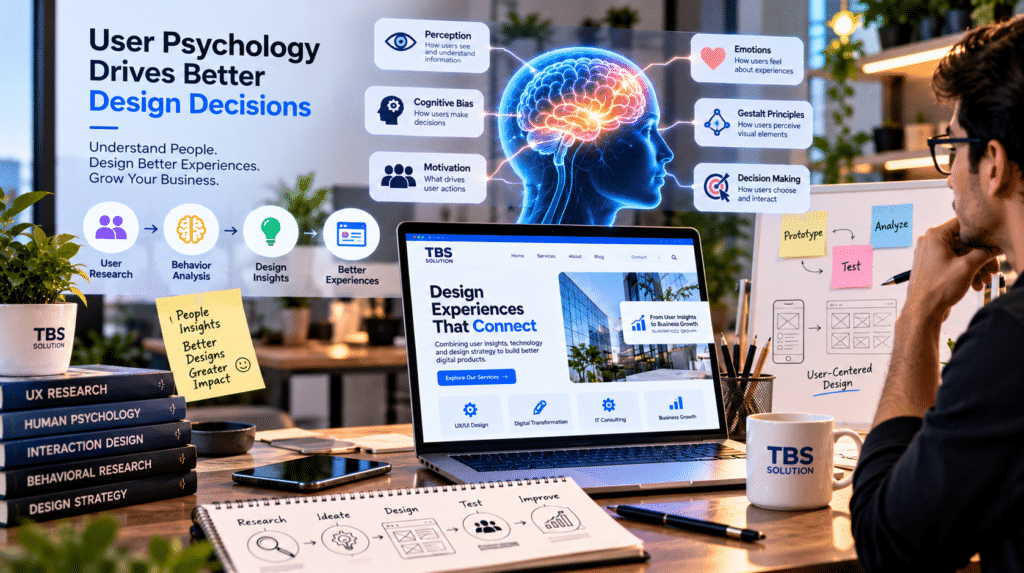
How Psychology Influences Navigation, Content and Visual Hierarchy
A user rarely enters a website asking, “What does the designer want me to look at?”
They arrive with a goal.
They might want to:
- Find a product
- Compare services
- Read an answer
- Contact a company
- Complete a purchase
- Understand a feature
- Solve a problem
Effective UX design helps them move toward that goal.
Visual hierarchy plays a major role.
A designer can use size, spacing, contrast, typography, positioning, and grouping to establish relationships between elements.
For example:
Primary heading → Supporting explanation → Key benefit → Action
creates a clearer information path than presenting every element with equal visual importance.
This is where interaction design becomes more than visual styling. It considers what happens before, during, and after each user action.
The Role of Prototyping in Understanding User Behavior
A prototype allows teams to test a design idea before investing heavily in development.
Prototype psychology is valuable because people can react differently to a real interaction than they do when simply looking at a static design.
A prototype can reveal:
- Where users hesitate
- Which elements they misunderstand
- Where navigation breaks down
- Whether terminology makes sense
- Whether users notice important information
- Whether a workflow feels unnecessarily complicated
The process can be simple:
Idea → Prototype → User Test → Observation → Revision
This reduces the risk of building an entire product around an assumption that has never been tested.
How UX Researchers Turn Behavioral Data Into Design Decisions
A UX researcher does more than collect opinions.
The research process should connect user evidence to specific design decisions.
For example:
Observation: Users repeatedly miss a secondary navigation option.
Research: Testing shows users expect that option to appear under a different category.
Design decision: Restructure the navigation based on the user’s mental model.
Validation: Test the revised structure with another group of users.
This creates a traceable connection between research and design.
It also makes a UX case study much stronger because the final design can explain not only what changed, but why it changed.
From User Research to Design Strategy
User psychology becomes more powerful when it is connected to broader design strategy.
A practical framework is:
OBSERVE → RESEARCH → UNDERSTAND → DESIGN → TEST → OPTIMIZE
Observe
Understand the existing customer journey and identify friction points.
Research
Collect qualitative and quantitative evidence from real users.
Understand
Identify behavioral patterns, expectations, motivations, and usability problems.
Design
Translate those findings into information architecture, interaction design, content structure, and visual decisions.
Test
Use prototypes and usability testing to evaluate the proposed solution.
Optimize
Use feedback and behavioral data to improve the experience continuously.
This approach prevents psychology from becoming a collection of interesting theories disconnected from actual business problems.
How to Test Whether a Design Decision Actually Works
A design decision should be treated as a hypothesis rather than an unquestionable conclusion.
For example:
“Users are abandoning this form because it contains too many fields.”
That is a hypothesis.
Testing can determine whether reducing unnecessary fields actually improves completion.
Useful measurements can include:
- Task completion rate
- Conversion rate
- Form abandonment
- Navigation errors
- Time to completion
- Search behavior
- Engagement with important features
- User satisfaction
- Support requests
The right metric depends on the purpose of the interface.
A faster task is not automatically a better experience if users leave confused or make more mistakes.
Common Mistakes When Using Psychology in Design
Designing From Assumptions
Designers should not assume that every user thinks the same way.
Using Psychological Principles as Rules
Psychological principles provide useful guidance, but context matters.
Confusing Visual Appeal With Usability
A beautiful interface can still have poor navigation or confusing interactions.
Ignoring Accessibility
An interface that works for one user group may create barriers for another. Accessibility should be considered during research, information architecture, interaction design, and testing.
Testing Too Late
Waiting until development is nearly complete can make important UX changes expensive.
Optimizing Only for Conversion
Conversion matters for many businesses, but a short-term increase should not come at the expense of clarity, trust, accessibility, or long-term customer experience.
User Psychology, Digital Transformation and Business Growth
For modern businesses, UX is increasingly connected to technology strategy.
A website or application may sit inside a larger ecosystem involving:
- Customer relationship management
- Ecommerce
- Analytics
- AI automation
- Enterprise software
- Cloud infrastructure
- Marketing systems
- Customer support
- Data intelligence
That means UX decisions can affect more than the interface itself.
For example, a redesigned customer portal may need to integrate with enterprise software solutions, data systems, authentication, analytics, and automation.
This is where Customer Experience Engineering, Digital Transformation, Data Intelligence & Decision Systems, and IT & Technology Consulting can work together.
Instead of treating design as an isolated creative activity, businesses can connect user needs with technology, data, and operational goals.

User Psychology and AI Search: Why Helpful UX Still Matters
The modern search environment increasingly includes AI-generated experiences such as AI Overviews and AI Mode.
Google’s 2026 guidance states that foundational SEO remains relevant for generative AI search. It also emphasizes unique, valuable, non-commodity content rather than special AEO or GEO tricks. Google says there is no need to create special llms.txt files or special markup simply to appear in AI search.
For this article, that means the focus should remain on:
- Clearly answering user questions
- Using descriptive headings
- Explaining concepts accurately
- Providing useful examples
- Covering related questions naturally
- Maintaining logical topical relationships
- Demonstrating genuine expertise
- Creating content that is useful beyond the search result
Structured data can also help search engines understand page content, although it does not guarantee a particular search appearance.
Google has also expanded Search Console reporting around generative AI and multimodal search, giving site owners more ways to understand how their content is surfaced across evolving search experiences.
How TBS Solution Can Connect Psychology With Better Digital Experiences
At a technology and digital transformation level, user psychology should not be separated from implementation.
A business may need to understand users, redesign an interface, improve an ecommerce journey, modernize software, integrate AI automation, or improve the overall customer experience.
A connected approach can combine:
Research → UX Strategy → Interaction Design → Technology → Data → Optimization
This is particularly relevant to businesses working on Digital Transformation, Customer Experience EngineeriAI & Intelligent Automation.ng, Enterprise Software Solutions, Business Growth & Strategy, and
The result is a design process where technology supports the user’s needs rather than forcing users to adapt to the technology.
Frequently Asked Questions
What is user psychology in UX design?
User psychology in UX design is the study and application of how people perceive, process information, make decisions, and behave when interacting with digital products.
Why is psychology important in UX?
Psychology helps designers understand user behavior and reduce unnecessary cognitive effort. It can influence navigation, information hierarchy, interaction patterns, feedback, and overall usability.
What does a UX researcher do?
A UX researcher studies users through methods such as interviews, surveys, observation, usability testing, and quantitative analysis to identify needs, behaviors, and usability problems.
What are Gestalt principles in design?
Gestalt principles describe ways people tend to organize and interpret visual information. Principles such as closure, similarity, proximity, continuity, and common fate can influence interface structure and visual relationships.
How does user research influence design decisions?
User research provides evidence about real user behavior and expectations. Designers can use that evidence to identify problems, develop solutions, test prototypes, and refine the final experience.
Is psychology enough to create good UX?
No. Psychology is one part of UX. Effective UX also requires research, accessibility, information architecture, interaction design, content, technology, testing, and continuous optimization.
Final Takeaway
User psychology shapes better UX design by helping businesses understand how people perceive information, make decisions, navigate interfaces, and respond to digital experiences.
The strongest design decisions do not come from psychology alone. They come from combining behavioral research, psychological principles, interaction design, prototyping, testing, and real user feedback.
The practical process is simple:
OBSERVE → RESEARCH → UNDERSTAND → DESIGN → TEST → OPTIMIZE
When this process is connected with digital transformation, customer experience engineering, technology consulting, data intelligence, and business strategy, UX becomes more than visual design. It becomes a way to build digital products that are easier to understand, easier to use, and better aligned with real customer needs.
And that is the real purpose of user psychology in design: not to make users behave the way a business wants, but to design systems that understand and support the people using them.
Google’s current guidance similarly emphasizes helpful, original, trustworthy, people-first content and warns against creating material primarily to manipulate search rankings.
Important publishing note: E-E-A-T ko strong banane ke liye page par real author/byline, author bio, relevant credentials/experience, original examples, supporting sources, clear “Who/How/Why” information, aur genuine TBS expertise where applicable add karna useful hoga. Google specifically recommends clear authorship and original effort; E-E-A-T itself is not a standalone ranking factor.