
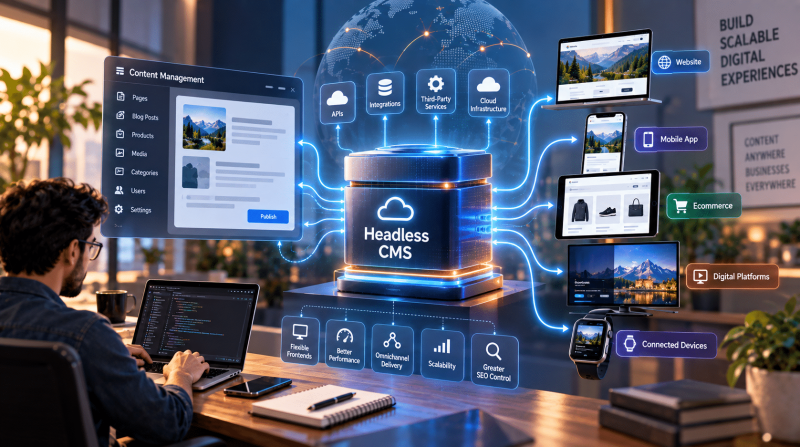
Modern websites are no longer limited to a single browser-based experience. Businesses increasingly need to deliver content across websites, mobile applications, ecommerce stores, digital platforms, connected devices, and emerging AI-powered experiences.
This shift is changing how organizations approach CMS architecture.
A traditional CMS typically connects content management with a specific presentation layer. A headless CMS separates the content management backend from the frontend, allowing developers to deliver the same content through APIs to different digital experiences.
For businesses investing in digital transformation, custom software development, ecommerce, and digital growth, this architecture can provide greater flexibility and control.
But is headless CMS development right for every business?
Not necessarily.
The right approach depends on your content requirements, development resources, SEO strategy, integrations, performance goals, and long-term technology roadmap.
This guide explains what a headless CMS is, its key features and benefits, headless CMS architecture, SEO considerations, ecommerce use cases, and how it compares with traditional CMS platforms.
What Is a Headless CMS?
A headless CMS is a content management system where the content management layer is separated from the presentation layer.
Instead of storing content and directly controlling how that content appears on a specific website, the CMS manages structured content and makes it available through APIs.
Developers can then use different frontend technologies to display that content.
For example, the same product or article content could potentially be delivered to:
- A corporate website
- A mobile application
- An ecommerce storefront
- A customer portal
- A digital kiosk
- A connected device
- Other digital experiences
This separation is the fundamental idea behind a headless approach.
In simple terms:
Traditional CMS: Content + Backend + Frontend are closely connected.
Headless CMS: Content management and frontend presentation are separated.
This gives development teams more freedom to choose the frontend technology that best fits the project.
How Does Headless CMS Development Work?
A typical headless CMS development architecture contains several key components.
1. Content Management Layer
Editors create and manage structured content through the CMS.
This can include:
- Blog posts
- Product information
- Landing pages
- Images
- Videos
- Categories
- Author information
- Customer-facing content
2. API Layer
The CMS exposes content through APIs.
These APIs allow applications and frontend systems to request the information they need.
3. Frontend
Developers build the frontend separately using technologies such as React, Next.js, Vue, Angular, or other modern frameworks.
4. Delivery Layer
The frontend consumes the content and presents it to users.
This architecture creates a clear separation between content management and presentation.
That separation is one of the biggest reasons businesses consider headless CMS development for modern digital platforms.
Key Headless CMS Features
The exact capabilities vary between platforms, but common headless CMS features include:
API-First Content Delivery
Content can be accessed through APIs rather than being tied to one frontend.
Structured Content
Content is organized into reusable fields and content models rather than being created only as complete webpages.
Multi-Channel Publishing
A single content source can support multiple digital experiences.
Flexible Frontend Development
Developers can select technologies based on project requirements instead of being locked into a CMS-specific frontend.
Content Reusability
The same content can be reused across websites, applications, ecommerce experiences, and other platforms.
Scalable Architecture
Headless systems can be integrated with cloud infrastructure, CDNs, APIs, databases, analytics platforms, and other services.
Developer Flexibility
Development teams can use modern frameworks and workflows that suit their technical requirements.
These features make headless architecture particularly attractive for organizations with complex digital ecosystems.

What Are the Benefits of Headless CMS?
The benefits of headless CMS go beyond simply separating the frontend from the backend.
Greater Frontend Flexibility
Developers are not restricted to the presentation layer built into a traditional CMS.
This makes it easier to create customized digital experiences.
Better Content Reusability
Content can be structured once and delivered to multiple platforms.
This can reduce duplication and make content management more consistent.
Omnichannel Content Delivery
Organizations managing websites, apps, ecommerce platforms, and other digital touchpoints can use a centralized content source.
Scalability
A properly designed architecture can support growing traffic, additional applications, and new digital experiences.
Improved Development Workflows
Frontend and content teams can work more independently, which can be useful for larger development organizations.
Greater Technology Freedom
Businesses can combine a CMS with modern frontend frameworks, cloud services, APIs, analytics platforms, and other technologies.
However, these benefits come with additional development and architectural responsibilities. A headless CMS isn’t automatically better simply because it uses newer technology.
Headless CMS vs Traditional CMS
The difference between headless CMS vs traditional CMS mainly comes down to how content and presentation are connected.
| Area | Traditional CMS | Headless CMS |
|---|---|---|
| Frontend | Usually connected | Separated |
| Content delivery | Website-focused | API-driven |
| Frontend flexibility | More limited | High |
| Multi-channel delivery | May require additional work | Core strength |
| Development | Often simpler initially | Usually more technical |
| Custom experiences | Depends on platform | Highly flexible |
| API usage | Varies | Central to architecture |
| Maintenance | Often simpler | Can require more technical resources |
A traditional CMS can still be the right solution for many businesses.
For example, a company that needs a straightforward marketing website may not need the additional complexity of a headless architecture.
Headless CMS becomes more compelling when a business needs multiple frontends, complex integrations, highly customized experiences, or scalable content delivery.
Headless CMS and SEO: What Developers Need to Know
One of the most important questions businesses ask is whether a headless CMS is good for SEO.
The answer depends on implementation.
Headless architecture does not automatically improve SEO. It gives developers greater control over the technical implementation, but that flexibility also creates responsibility.
A headless website should properly handle:
- Crawlable URLs
- Page titles
- Meta descriptions
- Canonical URLs
- Internal linking
- XML sitemaps
- Robots.txt
- Structured data
- Image optimization
- Mobile usability
- Page performance
- Rendering
- Indexable text
- Redirects
- HTTP status codes
JavaScript SEO is particularly important for modern headless implementations. Google explains that JavaScript-powered websites go through crawling, rendering and indexing processes, so developers need to make important content discoverable and accessible to search engines.
This means headless CMS SEO should be considered during architecture and development—not added as an afterthought.
Headless CMS, Performance and User Experience
Modern frontend frameworks can provide excellent performance when they are implemented correctly.
A headless architecture can support approaches such as:
- Server-side rendering
- Static generation
- Incremental regeneration
- CDN delivery
- Image optimization
- Code splitting
- Caching
- Edge delivery
However, architecture alone doesn’t guarantee a fast website.
Developers still need to monitor real-world performance and Core Web Vitals.
Google currently identifies LCP, INP and CLS as Core Web Vitals for loading performance, responsiveness and visual stability. Google’s recommended thresholds are LCP within 2.5 seconds, INP below 200 milliseconds and CLS below 0.1.
Therefore, the goal should be to combine flexible architecture with a strong website performance and user experience strategy.
Headless CMS for Ecommerce
Headless ecommerce CMS architecture is increasingly relevant for businesses that need customized shopping experiences.
An ecommerce business might have:
CMS → Product Data → API → Frontend → Cart → Checkout → Payment → Analytics
The CMS can manage content while ecommerce systems handle products, inventory, pricing, orders and transactions.
This separation allows businesses to create highly customized storefronts without forcing content management and ecommerce functionality into one system.
It can be particularly useful when an organization needs:
- Multiple storefronts
- International websites
- Personalized experiences
- Custom product interfaces
- Mobile applications
- Complex integrations
- Multiple content channels
For smaller stores with straightforward requirements, however, a traditional ecommerce platform may be easier and more cost-effective.
Headless CMS Use Cases
There are many potential headless CMS use cases.
Enterprise Websites
Large organizations can manage content centrally while delivering it across multiple websites and applications.
Ecommerce
Brands can build custom storefront experiences while connecting content with ecommerce platforms.
Mobile Applications
Content can be delivered to native or cross-platform mobile applications through APIs.
SaaS Platforms
Software companies can use structured content across marketing websites, documentation and application experiences.
Digital Portals
Customer portals and other specialized platforms can consume content from a centralized CMS.
Multi-Brand Organizations
Organizations with several brands or websites can potentially create reusable content structures and workflows.

When Should You Use a Headless CMS?
A headless CMS may be worth considering when you need:
- Multiple frontend experiences
- API-driven content delivery
- Highly customized interfaces
- Omnichannel publishing
- Complex integrations
- Modern frontend frameworks
- Enterprise-level scalability
- Greater control over frontend development
A traditional CMS may make more sense when:
- You have a simple website
- Your content is primarily web-based
- Your team has limited development resources
- You need fast implementation
- Advanced integrations aren’t necessary
The right CMS should be selected based on business requirements rather than technology trends.
Headless CMS and Modern Digital Transformation
Headless architecture can become part of a wider digital transformation strategy.
Instead of viewing the CMS as an isolated tool, businesses can connect it with:
CMS → APIs → Frontend → Cloud Infrastructure → Analytics → Automation → Customer Experience
This broader approach allows technology teams to build digital ecosystems rather than individual webpages.
For organizations investing in custom software development, enterprise software solutions, cloud infrastructure, DevOps, AI automation, data analytics and digital growth, headless architecture can be one component of a larger technology strategy.
The important question isn’t simply:
“Should we use a headless CMS?”
A better question is:
“What architecture will help us deliver the digital experiences our customers and business will need over the next several years?”
Headless CMS, AEO, GEO and AI Search
The growth of AI-powered search has created new discussions around AEO (Answer Engine Optimization), GEO (Generative Engine Optimization) and LLM visibility.
But businesses should avoid treating these as completely separate from SEO.
Google’s current guidance states that its AI search experiences are grounded in its core Search systems, and that existing SEO fundamentals remain important for AI Overviews and AI Mode.
For a headless website, that means important content should remain:
- Crawlable
- Indexable
- Clearly structured
- Available as text
- Internally linked
- Technically accessible
- Supported by accurate structured data where appropriate
Content should also answer real questions clearly.
For example, instead of writing vague content about headless architecture, a page can directly answer:
What is a headless CMS?
How does headless CMS development work?
Is headless CMS good for SEO?
What are the benefits of headless CMS?
What is the difference between headless and traditional CMS?
This creates a useful structure for both human readers and modern search systems.
Importantly, Google says there are no special AI markup requirements or llms.txt files required for appearing in AI search features. Google’s recommendation is to focus on foundational SEO, helpful content, crawlability and user experience instead.
How TBS Solution Approaches Modern Web Development
Headless CMS development should not be treated as an isolated technology decision.
At TBS Solution, modern digital projects can connect areas such as digital transformation, custom software development, enterprise software solutions, digital growth & SEO, AI and automation, cloud infrastructure and DevOps, quality engineering, and data intelligence.
This broader perspective is important because a modern web platform needs more than a CMS.
It needs:
Strategy → Architecture → Development → Performance → SEO → Analytics → Optimization
A well-designed technology stack should support the business today while remaining flexible enough to evolve as customer expectations and digital channels change.
For organizations considering a custom headless CMS, enterprise website, ecommerce platform, or API-driven digital experience, architecture should therefore be evaluated against business goals, technical requirements, content workflows, SEO requirements and long-term scalability.
Frequently Asked Questions
What is a headless CMS?
A headless CMS separates content management from the frontend presentation layer and typically delivers content through APIs.
What are the main benefits of headless CMS?
The main benefits include frontend flexibility, reusable content, multi-channel delivery, API-driven architecture, scalability and greater control over digital experiences.
Is headless CMS good for SEO?
A headless CMS can support strong SEO, but SEO performance depends on implementation. Crawlability, rendering, metadata, internal links, structured data, performance and indexable content all need to be handled correctly.
Is headless CMS better than traditional CMS?
Neither architecture is universally better. Headless CMS is generally more suitable for complex, multi-channel and highly customized digital experiences, while traditional CMS platforms can be simpler for straightforward websites.
What is headless CMS development?
Headless CMS development involves building a decoupled architecture where content is managed separately from the frontend and delivered through APIs to one or more digital experiences.
Can a headless CMS be used for ecommerce?
Yes. A headless ecommerce CMS can separate content and presentation from ecommerce functionality, allowing businesses to create customized storefronts and digital shopping experiences.
Final Takeaway
Headless CMS is changing modern web development by separating content from presentation and giving businesses greater flexibility over how digital experiences are built and delivered.
Its biggest advantages include:
Flexible Frontends → Reusable Content → API-Driven Delivery → Multi-Channel Experiences → Scalable Architecture
But headless architecture is not automatically the right choice for every organization.
The best approach is to evaluate your content requirements, development capabilities, SEO strategy, ecommerce needs, performance expectations, integrations and long-term business goals before selecting an architecture.
For SEO and AI-powered search, the fundamentals remain especially important. Google continues to emphasize helpful, reliable, people-first content, strong technical foundations, crawlability, accessibility and good page experience.
Google also emphasizes that unique, valuable and non-commodity content is more useful for generative AI visibility than attempts to exploit artificial AEO or GEO tactics.
Ultimately, the value of a headless CMS isn’t the technology itself. It’s what that architecture enables your business to build.
When the architecture, frontend, APIs, SEO, performance, analytics and business strategy work together, a headless CMS can become a powerful foundation for modern digital experiences.