
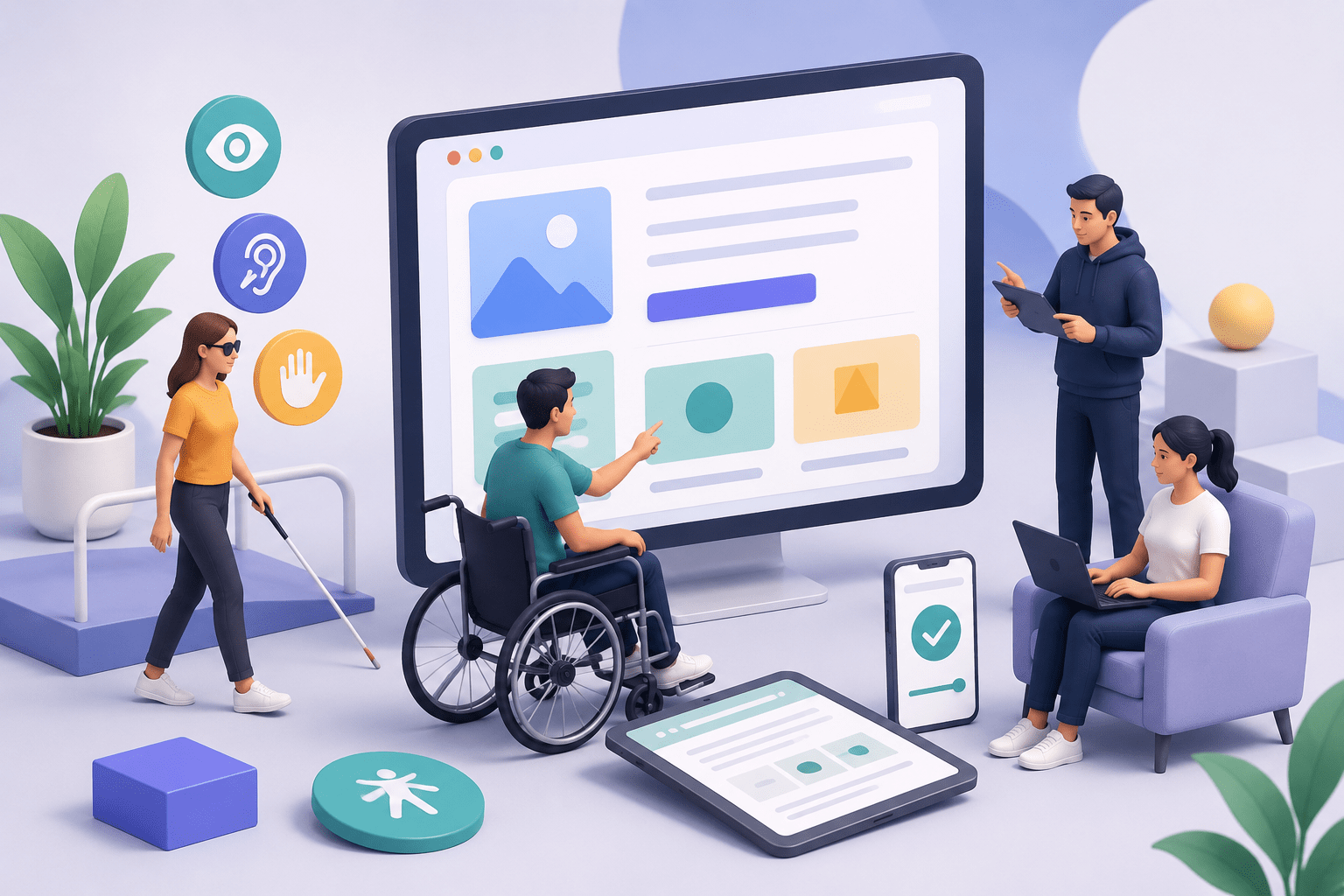
A website should be usable by as many people as possible. Yet many businesses focus heavily on appearance, animations, and features while overlooking accessibility. Website accessibility means designing and developing digital experiences that people with different abilities can navigate, understand, and use effectively.
For businesses investing in web development, accessibility is not simply a technical consideration. It can improve usability, expand audience reach, enhance the customer experience, and create a more inclusive digital presence.
What Is Website Accessibility?
Website accessibility is the practice of making websites usable for people with disabilities, including those with visual, hearing, mobility, or cognitive limitations.
- Keyboard friendly navigation
- Descriptive image alt text
- Clear headings and page structure
- Readable text and sufficient contrast
- Accessible forms
- Captions for relevant videos
- Clear and descriptive links
- Compatibility with assistive technologies
Accessibility should be considered from the beginning of the website development process, rather than added after a website has already been built.
Why Web Accessibility Matters for Businesses
A business website should not create unnecessary barriers between customers and the information they need.
If visitors struggle to navigate a website, understand content, complete a form, or interact with important features, they may leave before becoming customers.
Improving web accessibility can help businesses create a smoother experience for a wider audience.
It can also encourage development teams to build cleaner navigation, clearer content, and more consistent user interfaces.
Accessibility and User Experience Work Together
Accessibility and user experience are closely connected.
A simple navigation structure can help users with assistive technologies and make the website easier for everyone to use.
Similarly, readable typography benefits users with visual impairments while making content easier for mobile visitors.
Clear forms, descriptive buttons, logical headings, and consistent layouts can improve the overall user experience on the website.
This means accessibility improvements often benefit the entire audience rather than a single group of users.
The Importance of Accessible Website Navigation
Navigation is one of the most important parts of an accessible website.
Visitors should be able to understand where they are, where they can go, and how to return to previous sections.
Developers can improve navigation by using :
- Logical menus
- Descriptive page titles
- Proper heading structures
- Keyboard friendly controls
- Consistent layouts
- Clear link descriptions
A well organised website also helps search engines understand the relationship between different pages.
This makes accessible web design valuable from both usability and technical perspectives.
Make Website Content Easier to Understand
Accessibility is not only about code.
Content plays an important role as well.
Long blocks of text, unclear instructions, complicated language, and vague calls to action can make a website difficult to understand.
Businesses should use :
- Short paragraphs
- Descriptive headings
- Clear instructions
- Meaningful link text
- Simple language
- Helpful visual hierarchy
This approach improves content readability and makes the website easier to navigate.
Accessibility in WordPress and Shopify Websites
Accessibility should also be considered when developing websites on platforms such as WordPress and Shopify.
A WordPress development project may involve themes, plugins, custom components, forms, and page builders. Developers need to ensure these elements work together without creating unnecessary accessibility issues.
Similarly, Shopify development requires attention to product navigation, menus, forms, buttons, product information, and mobile shopping experiences.
Choosing an accessible theme is useful, but professional development and testing are still important when a business requires deeper customisation.
Mobile Accessibility Matters Too
Modern websites need to work across different devices.
A visitor may access a website from a desktop computer, tablet, or smartphone. Small buttons, difficult menus, low contrast, or poorly structured pages can become especially frustrating on smaller screens.
Responsive web development should therefore consider accessibility alongside screen size and performance.
A mobile friendly and accessible website can make it easier for customers to browse services, complete forms, shop for products, or contact a business.
Accessibility and SEO
Accessibility and SEO services are not the same, but they can support many of the same website improvements.
For example, descriptive headings, meaningful link text, useful alt text, logical page structure, and clear content can improve usability while also helping search engines understand website content.
However, accessibility should never be implemented simply as an SEO tactic. Its primary purpose is to make digital experiences more usable and inclusive.
How Businesses Can Improve Website Accessibility
Businesses can start with a practical accessibility review.
Check whether :
- Every important page has clear headings.
- Images have useful alternative text where appropriate.
- Forms provide understandable labels and instructions.
- Navigation works without relying entirely on a mouse.
- Text has sufficient contrast.
- Buttons and links clearly communicate their purpose.
- Websites work properly on mobile devices.
- Videos contain appropriate captions when needed.
Regular testing can help identify accessibility issues before they affect customers.
Build Accessibility Into Your Development Strategy
Accessibility should be considered during planning, design, development, testing, and maintenance.
For businesses working with a professional web development company, discussing accessibility requirements early can prevent expensive changes later.
It can also encourage developers and designers to think about real users rather than designing only for an ideal browsing environment.
Final Thoughts
Website accessibility is an important part of creating modern digital experiences. An accessible website can make information easier to understand, navigation easier to use, and online services more available to a wider audience.
For businesses investing in web development, WordPress, Shopify, SEO, ecommerce, and digital solutions, accessibility should be treated as part of building a quality website not as an optional feature added at the end.
A website should not only look good. It should be usable, understandable, reliable, and welcoming to the people it is designed to serve.