
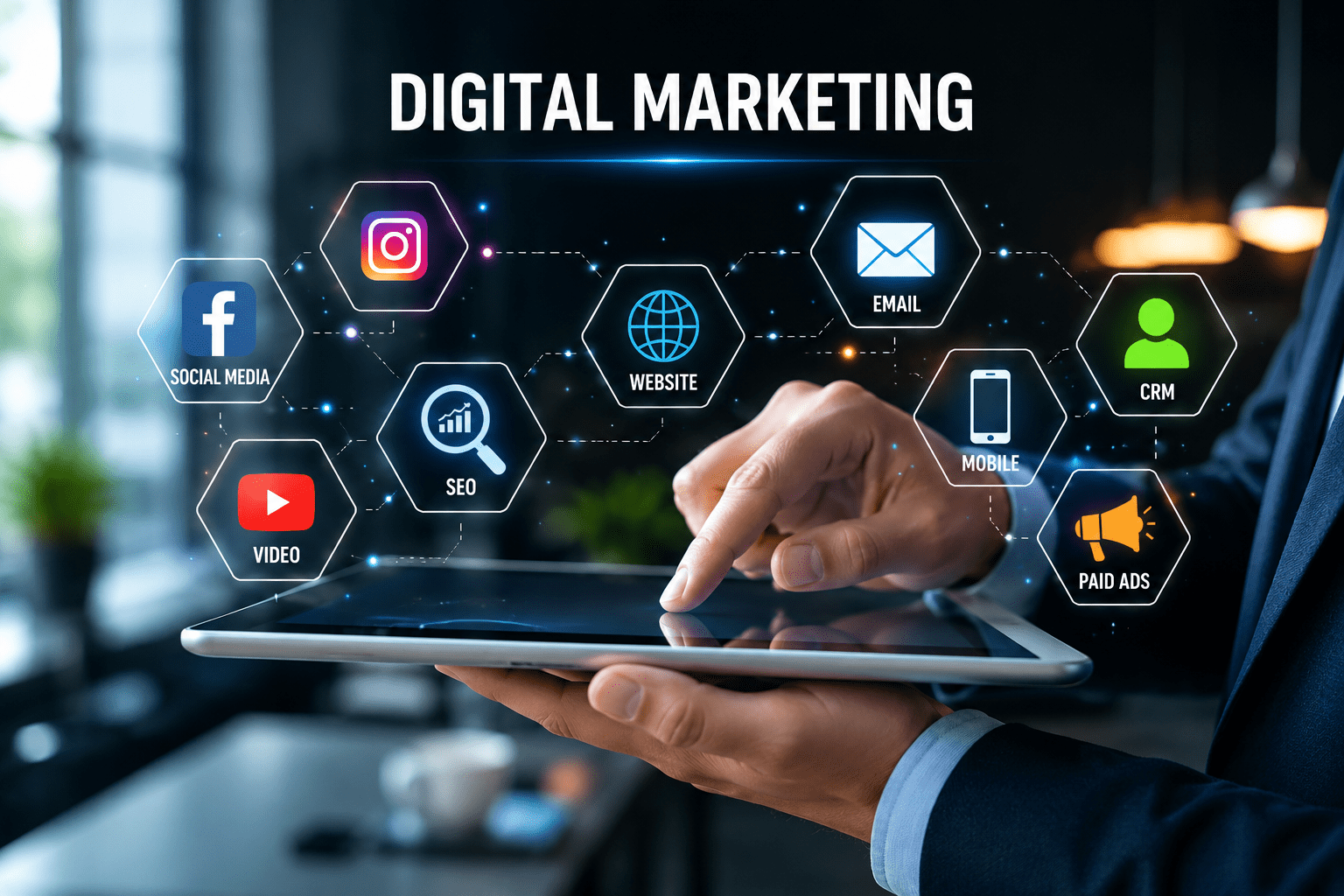
Businesses today have more ways to reach customers than ever before. They can use search engines, social media, email, paid advertising, ecommerce platforms, websites, CRM systems, and other digital channels to attract and engage their audiences.
But having many channels does not automatically create a strong marketing strategy. The real problem begins when a business becomes too dependent on a single platform for traffic, leads, sales, or customer communication.
This is known as platform dependency in marketing. While one platform may deliver excellent results for a period of time, changes to algorithms, advertising costs, account restrictions, competition, or customer behavior can quickly affect performance.
A more sustainable approach is to build a multi-channel marketing strategy supported by owned digital assets, SEO, automation, and strong customer relationships.
What Is Platform Dependency in Marketing?
Platform dependency occurs when a business relies heavily on one external platform to generate most of its marketing results.
For example, a company might receive almost all of its website visitors from Google, depend entirely on Facebook or Instagram for leads, or generate most of its sales through one ecommerce marketplace.
The problem is not using these platforms. They can be extremely valuable marketing channels.
The risk comes from having no reliable alternatives.
If an algorithm changes, advertising becomes more expensive, organic visibility decreases, or an account experiences restrictions, the business may suddenly lose a significant portion of its traffic and revenue.
Why Relying on One Marketing Channel Is Risky
Algorithm Changes Can Affect Visibility
Search engines and social media platforms continuously update how content is distributed.
A strategy that performs well today may produce different results after a major algorithm change.
Businesses that diversify their traffic sources are generally better positioned to adapt because they are not relying entirely on one source of visibility.
Advertising Costs Can Increase
Paid advertising can generate fast results, but businesses do not control the cost of competing for advertising space.
As competition increases, cost per click and customer acquisition costs can rise.
A company that depends entirely on paid traffic may find it difficult to maintain profitable growth when advertising costs increase.
Platform Policies Can Change
External platforms control their own rules, features, algorithms, and account policies.
A policy change can affect how businesses advertise, communicate with customers, or distribute content.
This is another reason why businesses should build assets they have greater control over.
Build Your Own Digital Assets
One of the strongest ways to reduce platform dependency is to invest in owned digital assets.
Your business website is one of the most important examples.
A professionally developed website gives a business greater control over its brand, content, customer journey, lead-generation process, and digital experience.
A strong web development strategy can also connect the website with CRM systems, analytics, ecommerce platforms, booking tools, and automation.
For businesses that need a stronger online foundation, consider linking the phrase web development services to the relevant TBS Solution service page.
SEO Can Create a More Sustainable Traffic Source
Search engine optimization can help businesses build long-term organic visibility.
Unlike paid advertising, where traffic generally stops when spending stops, a well-optimized website can continue attracting visitors through organic search.
However, SEO should not be viewed as a shortcut.
A sustainable SEO strategy requires useful content, technical optimization, strong website architecture, relevant internal links, good user experience, and continuous improvement.
Businesses can naturally link SEO services to the relevant TBS Solution service page in this section.
SEO also works best when it supports other marketing channels rather than operating independently.
Email Marketing Gives You Direct Customer Communication
Email is another important way to reduce dependency on external platforms.
A social media follower can become difficult to reach if platform visibility changes. An appropriately collected email subscriber, on the other hand, gives businesses a more direct communication channel.
Email marketing automation can help businesses nurture leads, communicate with customers, promote products, and encourage repeat purchases.
Businesses can create workflows based on actions such as:
- Website form submissions
- Product purchases
- Email engagement
- Abandoned carts
- Appointment bookings
- Customer inactivity
This makes email more than a newsletter. It becomes part of an automated customer journey.
Combine Marketing With CRM Automation
A strong CRM automation strategy can help businesses organize customer information and coordinate marketing and sales activities.
For example:
Website Visit → Lead Form → CRM → Automated Follow-Up → Sales Conversation
Instead of manually moving information between different systems, businesses can connect their website, CRM, email marketing, and automation workflows.
This can improve response times while reducing repetitive administrative work.
If TBS Solution has a dedicated CRM or automation service page, the phrase CRM automation is a natural internal-link opportunity.
Use Multiple Channels With One Clear Strategy
Multi-channel marketing does not mean posting everywhere without a plan.
The goal is to create a connected system where different channels support one another.
For example:
SEO → Website → Lead Magnet → Email → CRM → Sales
Or for ecommerce:
Social Media → Product Page → Email → Retargeting → Purchase → Post-Purchase Email
Each channel has a different role, but the customer experience remains connected.
This approach is more effective than treating every marketing channel as a separate activity.
Ecommerce Businesses Should Avoid Marketplace Dependency
Ecommerce businesses can face particularly high platform dependency.
Selling through marketplaces can provide access to large audiences, but businesses may have limited control over customer relationships, platform rules, fees, and visibility.
A strong ecommerce strategy can combine marketplace sales with an owned ecommerce website.
For businesses using Shopify, a professionally optimized Shopify development strategy can help create a stronger owned sales channel.
Relevant Shopify or ecommerce service pages on the TBS Solution website can be linked using anchors such as ecommerce development.
AI and Automation Can Strengthen Multi-Channel Marketing
Modern businesses can also use AI and automation to manage marketing activities more efficiently.
AI automation can assist with tasks such as customer communication, lead qualification, workflow management, content processes, and customer support.
Automation can connect multiple channels so that customer actions trigger appropriate next steps.
For example, a website visitor who submits a form could automatically enter a CRM, receive a personalized email, and be assigned to a sales representative.
This creates a connected marketing system rather than a collection of disconnected tools.
The phrase AI automation can also be used as an internal link to the relevant TBS Solution service page.
How to Build a Platform-Independent Marketing Strategy
Businesses do not need to abandon platforms that already work.
Instead, they should gradually reduce excessive dependence.
A practical strategy can include:
1. Build a Strong Website
Make your website the central hub for your digital presence.
2. Invest in SEO
Create sustainable organic visibility through useful content and technical optimization.
3. Build an Email List
Develop direct communication with prospects and customers.
4. Use CRM and Automation
Connect customer data and marketing workflows.
5. Diversify Traffic Sources
Combine organic search, email, social media, paid advertising, referrals, and other appropriate channels.
6. Measure Channel Performance
Track where leads, customers, and revenue actually come from.
This helps businesses identify dangerous levels of dependency before they become a serious problem.
Measure More Than Traffic
A business should not judge marketing diversification simply by counting visitors.
Important metrics include:
- Qualified leads
- Conversion rate
- Customer acquisition cost
- Revenue by channel
- Customer lifetime value
- Email engagement
- Organic search traffic
- Paid advertising performance
- Returning customers
Looking at these metrics together can reveal whether a business is building sustainable growth or simply shifting from one platform dependency to another.
Final Thoughts
Platform dependency in marketing is not about avoiding Google, social media, paid advertising, marketplaces, or other digital platforms. These channels can play an important role in business growth.
The real objective is to avoid making any single external platform responsible for the majority of your traffic, leads, or revenue.
A stronger approach combines web development, SEO, email marketing, CRM automation,ecommerce,AI automation, and multiple acquisition channels into one connected digital strategy.
When businesses build valuable owned assets while using external platforms strategically, they gain more control, greater flexibility, and a stronger foundation for long-term growth.
The best marketing strategy is not necessarily the one that generates the most traffic today. It is the one that continues creating opportunities when the digital environment changes tomorrow.