

Businesses often face the same marketing question: Should we invest in creating our own content or pay influencers to reach an established audience?
There isn’t a one-size-fits-all answer to which strategy is better.
Both content marketing and influencer marketing can help you build awareness, engagement, leads, and revenue. They work differently, though. Content marketing builds long-term assets, while influencer marketing gives you quicker access to an established audience.
Which strategy delivers better ROI depends on your goals, budget, audience, buying cycle, and how fast you want results.
Quick Answer: Which Delivers Better ROI?
For most businesses, content marketing usually gives a better long-term ROI, especially if your customers look for information before buying.
Content keeps bringing in traffic, leads, and brand awareness long after it’s published.
Influencer marketing can get you results faster, especially if you need quick awareness, social proof, product exposure, or access to a specific audience.
Content marketing helps you build valuable assets, while influencer marketing can quickly draw attention to them.
Content Marketing 101: What Are You Actually Investing In?
Content marketing means creating and sharing helpful, relevant content to attract and connect with a specific audience.
It’s about much more than just posting blogs.
A complete content marketing strategy may include:
- Blog articles
- SEO content
- Videos
- Case studies
- Guides
- Landing pages
- Email content
- Social media content
- Whitepapers and resources
The key question isn’t just, “What content should we make?”
What job should this content perform for the business?
Types of Content and Their Primary Purpose
| Content Type | Primary Purpose |
| Blog articles | Organic visibility and education |
| Case studies | Trust and credibility |
| Guides | Lead generation and education |
| Videos | Engagement and explanation |
| Landing pages | Conversion |
| Email content | Nurturing and retention |
| Social content | Awareness and distribution |
A good content marketing strategy ties these assets to
your customer’s journey
Conversion
This is why content marketing works especially well for businesses with longer buying cycles. eting:
What Are You Actually Paying For?
Influencer marketing: Influencer marketing lets your business team up with people who already have an audience and trust in a certain community.
In an influencer campaign, a business is usually paying for a combination of:
- Audience access
- Content creation
- Distribution
- Social proof
- Brand exposure
Different types of influencer marketing may include:
- Nano influencers
- Micro influencers
- Macro influencers
- Celebrity or mega influencers
- Affiliate partnerships
- Brand ambassadors
- Sponsored campaigns
- Long-term creator partnerships
The best choice isn’t always the influencer with the biggest following.
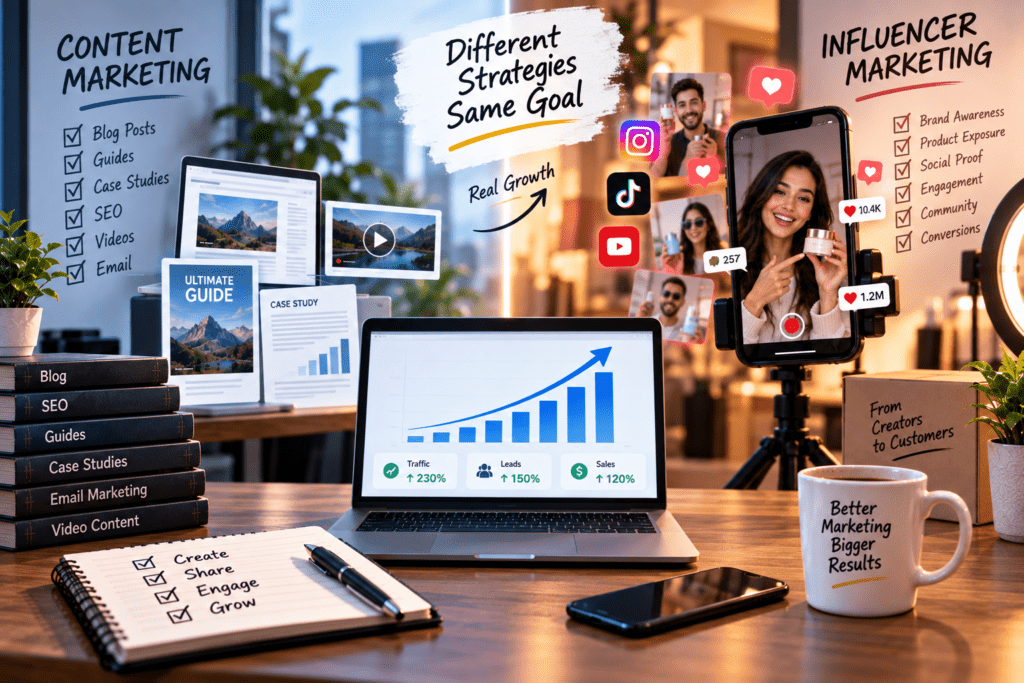
Content Marketing vs. Influencer Marketing:
The Key Differences
| Factor | Content Marketing | Influencer Marketing |
| Speed of results | Usually slower | Often faster |
| Long-term value | Can compound over time | Often campaign-dependent |
| SEO potential | High | Usually indirect |
| Audience ownership | Brand builds its own audience | Access depends on the creator |
| Trust building | Developed gradually | Can leverage existing trust |
| Lead generation | Strong for research-driven buyers | Depends on campaign and funnel |
| Scalability | Content assets can continue working | Usually requires continued investment |
| Best for | Long-term growth | Awareness and audience access |
The Biggest ROI Difference: Compounding Value vs. Campaign Impact
This is where things get more interesting.
Content Marketing Can Create Compounding Value
A great article, guide, case study, or video can keep bringing value long after you’ve created it.
For example:
A business publishes a useful article that answers an important customer question.
Over time, that content may:
- Reach new audiences
- Generate search visibility
- Build authority
- Attract backlinks or mentions
- Generate leads
- Support future sales conversations
This does not mean every article will perform well forever.
Content still requires research, quality control, promotion, updates, and measurement.
However, successful content can keep delivering value long after it’s published.
Influencer Marketing Often Creates Immediate Campaign Impact
Influencer marketing usually follows a different timeline.
Potential Conversions
This can create momentum quickly.
However, when the campaign ends, the business may need to continue investing to maintain the same level of exposure.
Content marketing can help you build attention over time. Influencer marketing can help you access attention faster.
Which Strategy Is Better for Lead Generation?
The answer depends heavily on how customers make purchasing decisions.
Content Marketing Is Often Better When Customers Research Before Buying
Content marketing can be highly valuable when customers:
- Search for answers before purchasing
- Compare different solutions
- Need education
- Have a longer buying cycle
- Require trust before converting
For example, B2B services, software, professional services, and complex products often benefit from educational content.
A potential customer may discover an article today and become a lead weeks or months later.
This makes content marketing lead generation particularly useful for businesses focused on building a sustainable pipeline.
Influencer Marketing Can Be Strong for Discovery and Social Proof
Influencer marketing may perform better when:
- Products are easy to demonstrate
- Visual content matters
- Social proof influences buying decisions
- The audience spends significant time on social platforms
- The business needs awareness quickly

How Should You Measure ROI?
One of the biggest mistakes businesses make is comparing two strategies using completely different metrics.
For example, comparing:
Blog traffic
with
Influencer-driven sales
Basic ROI Formula
Content Marketing Analytics
Useful metrics may include:
- Organic traffic
- Qualified leads
- Conversion rate
- Assisted conversions
- Cost per lead
- Content-driven revenue
- Customer acquisition contribution
A successful article does not necessarily need millions of visits.
Influencer Marketing Reporting
Useful metrics may include:
- Relevant reach
- Engagement
- Website visits
- Campaign clicks
- Affiliate sales
- Promo code usage
- Leads
- Revenue
Follower count alone should not determine campaign success.
The 5-Question ROI Decision Framework
1. How Quickly Do You Need Results?
If you need awareness quickly, influencer marketing may provide faster exposure.
2. Do Customers Search for Your Solution?
3. Does Your Product Benefit From Visual Demonstration?
4. Do Customers Need Education Before Buying?
5. Are You Building a Long-Term Marketing Asset?
When Combining Both Strategies Can Produce Better ROI
The most effective strategy may combine content and influencer marketing.
Instead of asking influencers to send traffic directly to a generic homepage, businesses can create a stronger conversion journey.
For example:
Conversion
In this model, influencer marketing generates attention while content marketing helps capture, educate, and nurture that audience.
Common Mistakes That Reduce ROI
Content Marketing Mistakes
- Publishing content without understanding audience demand
- Creating content without a clear business purpose
- Measuring only traffic
- Ignoring lead quality
- Never updating important content
Influencer Marketing Mistakes
- Choosing creators based only on follower numbers
- Ignoring audience relevance
- Running campaigns without tracking
- Using vanity metrics as the main success measurement
- Treating every influencer campaign as a one-time transaction
Final Verdict: Content Marketing or Influencer Marketing?
If your goal is long-term visibility, authority, organic traffic, and sustainable lead generation, content marketing will often provide stronger long-term ROI.
If your goal is rapid awareness, social proof, product exposure, or fast access to a relevant audience, influencer marketing may deliver results more quickly.
Choose Content Marketing When You Want:
- Long-term organic visibility
- Search traffic
- Educational content
- Lead generation
- Authority and trust
- Reusable marketing assets
Choose Influencer Marketing When You Want:
- Faster awareness
- Audience access
- Social proof
- Product exposure
- Campaign momentum
Consider Combining Both When:
Content marketing helps you build the foundation. Influencer marketing helps you accelerate awareness.
The goal should not be to choose the strategy that looks most popular.
Frequently Asked Questions
Is content marketing better than influencer marketing?
Which strategy usually has better long-term ROI?
Is influencer marketing worth it for small businesses?
How does content marketing generate leads?
Can content marketing and influencer marketing work together?
What is the best way to measure marketing ROI?