
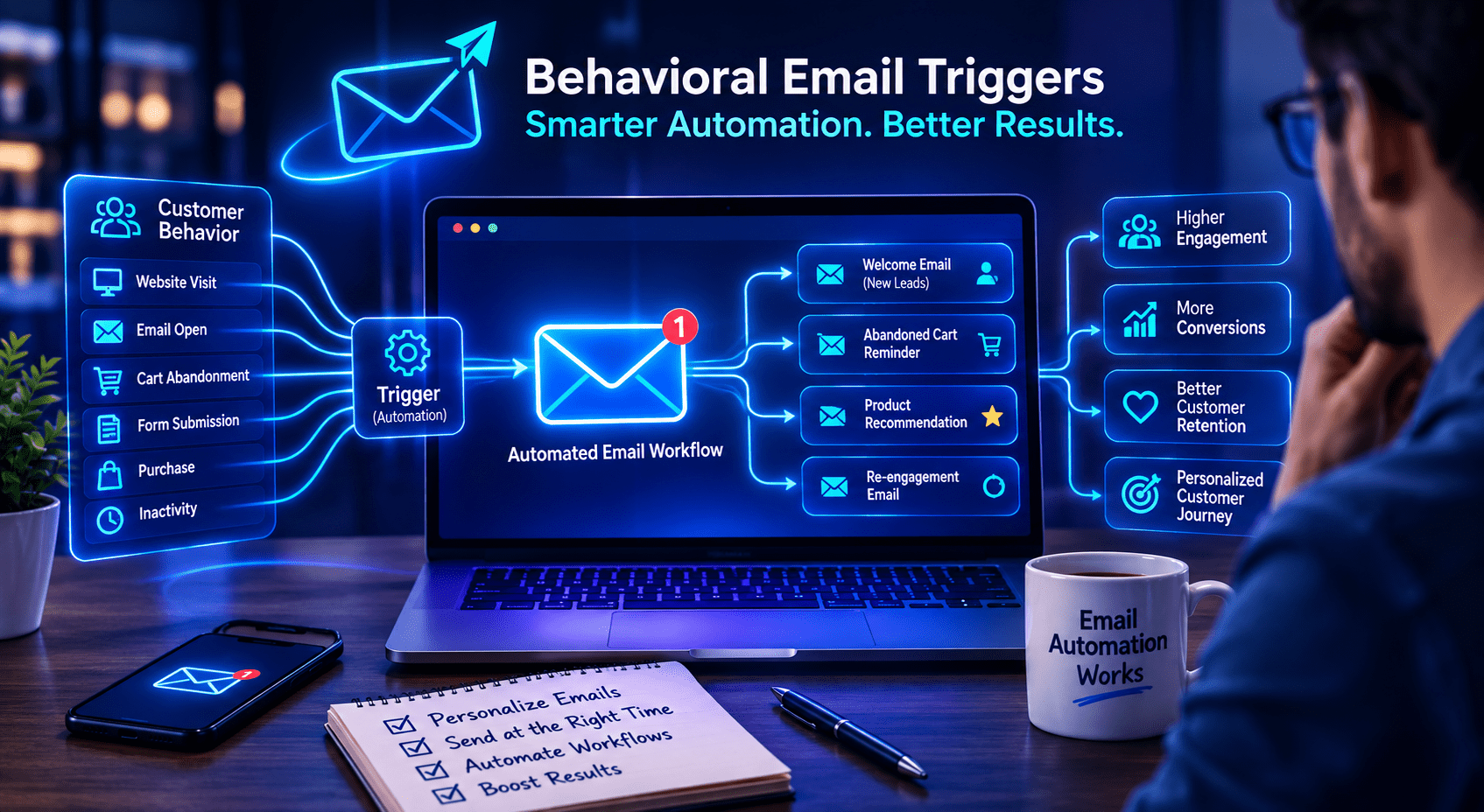
In today’s competitive digital landscape, sending the same email to every customer is no longer enough. Customers expect businesses to understand their interests, actions, and needs. This is where behavioral email triggers can make email marketing more relevant and effective.
Behavioral email triggers allow businesses to send automated messages based on specific customer actions. A website visit, email click, form submission, abandoned cart, purchase, or period of inactivity can automatically trigger a relevant email.
When combined with email automation, these triggers help businesses deliver the right message at the right moment while improving customer engagement, lead nurturing, conversions, and retention.
What Are Behavioral Email Triggers?
Behavioral email triggers are automated conditions that send an email when a customer performs a specific action or reaches a particular stage in the customer journey.
Instead of relying only on a fixed email schedule, behavioral email marketing responds to what users actually do.
For example, a business can automatically send:
A welcome email after someone submits a form
A follow-up email after a website visitor downloads a resource
An abandoned cart email after a customer leaves products behind
A product recommendation after a purchase
A re-engagement email after a customer becomes inactive
These triggered emails make communication more timely and personalized.
How Behavioral Email Automation Works
A behavioral email automation workflow usually starts with a customer action. The marketing system detects that action and checks whether it matches a predefined condition.
For example:
Customer action → Trigger → Automated workflow → Personalized email → Customer response
Suppose a visitor views a service page several times but does not submit a contact form. An automated system can identify this behavior and send a relevant follow-up email or place the visitor into a lead nurturing campaign.
This approach allows businesses to use customer behavior data to create more relevant communication without manually sending every message.
Why Behavioral Email Automation Matters for Businesses
The biggest advantage of behavioral email marketing is timing. A customer is more likely to engage with a message when it relates directly to something they have just done.
Delivering Emails at the Right Time
Timing can have a major impact on email engagement. A message sent immediately after a relevant customer action can be more useful than a generic email sent days later.
For example, an abandoned cart email is most valuable when it reaches the customer while the purchase is still fresh in their mind.
With automated email campaigns, businesses can respond to customer actions without depending on manual follow-ups.
Creating Personalized Customer Experiences
Personalized email marketing is another major benefit of behavioral triggers. Instead of sending identical content to everyone, businesses can create different messages for different customer behaviors.
A new lead may receive educational content, while an existing customer may receive product recommendations or renewal reminders.
This creates a more relevant customer experience and can help businesses build stronger relationships with their audiences.
Common Behavioral Triggers for Email Marketing
There are many customer actions that can be used to start an automated email workflow.
Website Visits and Page Views
Website behavior can provide valuable information about customer interests. When a visitor repeatedly views a specific service or product page, that activity can become part of a behavior-based email marketing strategy.
Businesses can use website visitor tracking and marketing automation to segment users based on their interests and deliver more relevant follow-up content.
Email Opens and Clicks
Email engagement can also trigger additional communication.
For example, if a subscriber clicks a link about a particular service, the next email can provide more information about that topic.
This creates a more personalized email journey based on actual engagement rather than assumptions.
Abandoned Shopping Carts
For ecommerce businesses, abandoned cart emails are one of the most common applications of email automation.
When a customer adds products to their cart but does not complete the purchase, an automated email can remind them about the items they left behind.
An effective abandoned cart recovery strategy can help businesses recover potential sales and improve ecommerce performance.
Form Submissions and Lead Generation
Form submissions are another valuable trigger.
When someone requests information, downloads a resource, or submits a consultation form, businesses can automatically start a lead nurturing email sequence.
The first email might confirm the request, followed by educational content and relevant offers based on the lead’s interests.
Purchases and Customer Activity
Customer purchases can trigger post-purchase communication, product recommendations, review requests, and customer retention campaigns.
This makes customer lifecycle marketing more organized and helps businesses maintain communication beyond the initial sale.
How to Build a Behavioral Email Automation Strategy
A successful behavioral email automation strategy requires more than simply creating automated messages.
1. Identify Important Customer Actions
Start by identifying the actions that provide meaningful information about customer intent.
These may include:
Website visits
Form submissions
Email clicks
Product views
Purchases
Downloads
Cart abandonment
Appointment bookings
Long periods of inactivity
Not every action needs an automated email. Focus on behaviors that indicate genuine interest or require a useful response.
2. Define the Right Email Trigger
Once important behaviors are identified, determine which action should start each workflow.
For example:
Form submission → Welcome email
Product purchase → Post-purchase email
Cart abandonment → Recovery email
No activity for 60 days → Re-engagement email
Clear triggers help create organized and predictable email marketing automation.
3. Create Relevant Email Content
The email should match the customer’s action.
If someone downloads a guide about SEO, sending them unrelated content may reduce engagement. Instead, follow up with useful information about SEO strategy, website optimization, or related services.
Relevant content is one of the foundations of effective personalized email marketing.
4. Set the Right Timing
Timing should depend on the customer behavior and business goal.
Some emails should be delivered immediately, while others may work better after several hours or days.
Testing different timing options can help businesses discover when their audiences are most responsive.
5. Test and Optimize Your Automated Campaigns
Email automation should not be treated as a “set it and forget it” system.
Monitor campaign performance and test different:
Subject lines
Email content
Calls to action
Sending times
Customer segments
Follow-up sequences
Continuous optimization can improve overall email campaign performance.
Best Practices for Behavioral Email Marketing
Following a few important practices can make behavioral email campaigns more effective.
Personalize Emails Based on Customer Behavior
Use relevant customer information to make emails more useful. Personalization can include products viewed, services requested, previous purchases, or content preferences.
Avoid Sending Too Many Automated Emails
Automation does not mean customers should receive an email after every action.
Too many messages can lead to email fatigue, unsubscribes, and lower engagement. Build sensible rules and frequency limits into your workflows.
Use Customer Segmentation
Email segmentation allows businesses to group customers according to behavior, interests, purchase history, or engagement.
Behavioral segmentation can then be used to create more targeted automated email campaigns.
Monitor Email Performance
Track important metrics such as open rate, click-through rate, conversion rate, unsubscribe rate, and overall customer engagement.
These email marketing metrics can reveal which workflows are working and where improvements are needed.
Benefits of Using Behavioral Email Triggers
Businesses can gain several benefits from implementing behavioral email automation.
Higher Customer Engagement
Relevant messages are more likely to capture attention than generic emails.
Better Lead Nurturing
Automated workflows allow businesses to educate and follow up with leads throughout the buying journey.
Increased Conversions
Timely messages can encourage customers to complete purchases, book appointments, request information, or take another desired action.
Improved Customer Retention
Post-purchase communication and re-engagement campaigns can help businesses maintain relationships with existing customers.
More Efficient Marketing
Once properly configured, automated email workflows can handle repetitive communication while marketing teams focus on strategy and creative work.
How AI Can Improve Behavioral Email Campaigns
Artificial intelligence is adding another layer of intelligence to email marketing automation.
AI-powered email marketing systems can analyze customer interactions, identify patterns, personalize content, and help determine which messages may be most relevant to different audiences.
Businesses can combine AI email automation with behavioral triggers to build smarter customer journeys.
For example, AI can help identify customers who are highly engaged, recommend relevant content, or assist in creating personalized follow-up messages.
This can make marketing automation more scalable while reducing repetitive manual work.
How to Measure Behavioral Email Campaign Performance
Measuring performance is essential for improving behavioral email campaigns.
Important metrics include:
Open Rate
Shows how many recipients opened the email.
Click-Through Rate
Measures how many recipients clicked links or calls to action.
Conversion Rate
Shows how many recipients completed the desired action.
Customer Engagement
Helps businesses understand how actively subscribers interact with their emails.
Return on Investment
Comparing campaign results with marketing costs can help businesses determine the overall value of their email automation strategy.
Final Thoughts on Behavioral Email Automation
Behavioral email triggers help businesses move beyond generic email marketing by responding to real customer actions. When combined with effective email automation, customer segmentation, personalization, and thoughtful timing, they can create more relevant and useful communication throughout the customer journey.
From abandoned cart recovery and lead nurturing to post-purchase campaigns and customer re-engagement, behavioral email marketing gives businesses a practical way to deliver the right message at the right moment.
As AI and marketing automation continue to evolve, businesses that use customer behavior intelligently can create more personalized experiences, improve engagement, and build scalable automated email campaigns that support long-term growth.